
Chippewa VINELink Release Coverage
Michigan participates in MI-VINE through VINELink. The official Michigan material supports county jail notices for release, transfer, and escape, along with selected court events. For Michigan Department of Corrections prisoners, the system supplies a “general release” notification. It is a person-specific alert and lookup service, not a list of everyone released from Chippewa County.
The custody boundary matters here. VINELink may relay a Chippewa County Correctional Facility event or an MDOC event from Chippewa Correctional Facility or Kinross Correctional Facility. It does not replace the BOP locator for a federal prisoner, the ICE locator for immigration custody, or the court and agency record that proves an exit. The agency named on the result tells the reader which custodian to contact.
| Population | VINELink role | Primary confirmation |
|---|---|---|
| Chippewa County jail detainee | County release, transfer, or escape event when contributed | Sheriff release sheet or direct jail response |
| MDOC prisoner | General release notification | OTIS status, Date Paroled, or MDOC record |
| Federal prisoner | Not the controlling locator | BOP Inmate Locator |
| Immigration detainee | Not the controlling locator | ICE ODLS and responsible ERO office |
Search Chippewa Inmates on VINELink
Begin at the official Michigan VINELink portal and make sure Michigan is selected. Search by name and add the offender or booking identifier when one is available. Common names, aliases, exact spelling, and data entry differences can produce false matches or missed results, so a name alone is not enough for a firm identity match.
- Choose the offender or custody search for Michigan.
- Enter the person’s name and an offender or booking number when known.
- Compare the matches by identity facts, identifier, agency, and custody details.
- Open only the record that matches the known person.
- Write down the exact status or event, effective date, agency, and identifier.
- Follow the named custodian when the event says transfer, or corroborate a release with the Sheriff or MDOC.
The official search landing screen shows the starting point for a Michigan person check.
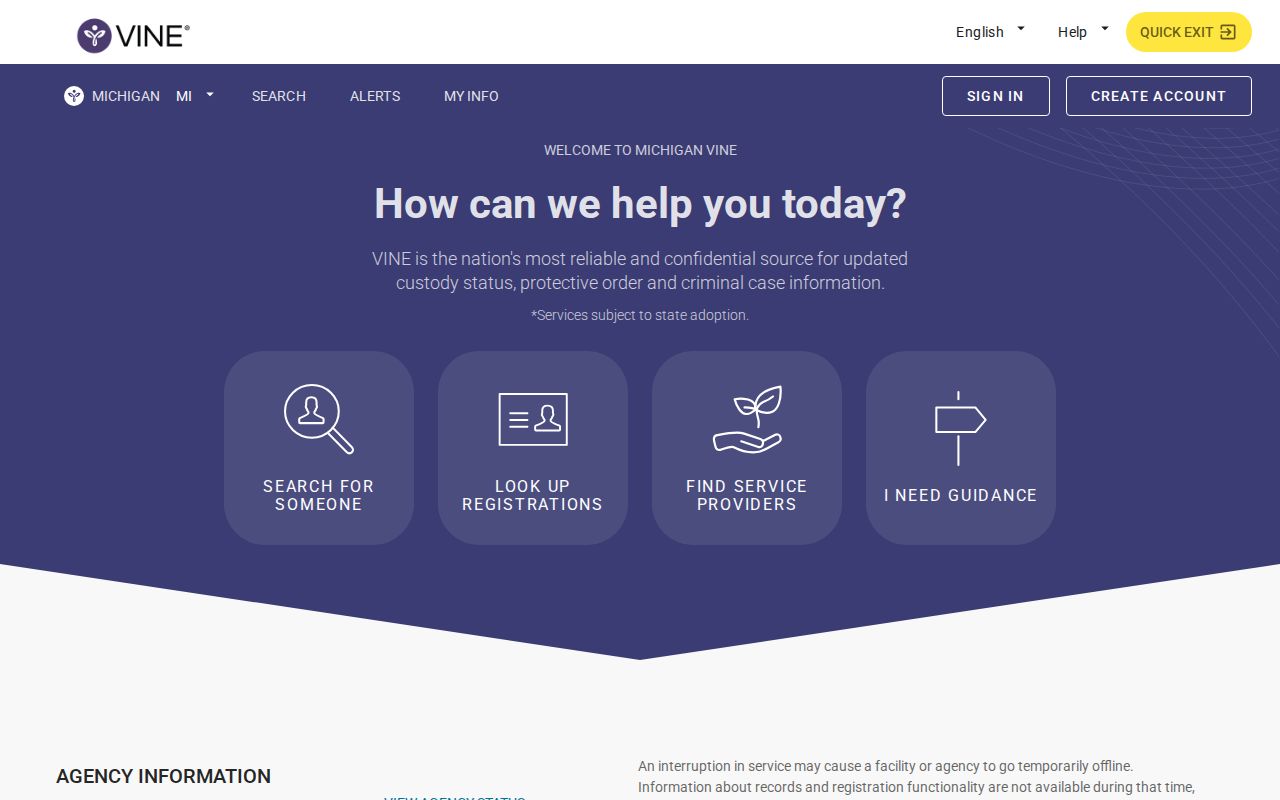
For a county-only event, the Chippewa County released-inmate search adds jail, court, and records-request checks to the VINELink result. That extra step is useful when the alert gives an event but not a durable document.
Note: Record the source agency as well as the status, since the same person may have county, state, or federal custody history.
Chippewa VINELink Release Fields
The exact record depends on what the contributing agency sends. Michigan’s official material supports a custody event or status tied to the individual and agency, but it does not promise that each Chippewa County result will retain a release date or photograph forever. Transcribe what appears without adding fields from another database.
| Field | How to read it |
|---|---|
| Person’s name | Starting identity fact that must be checked against other details. |
| Offender or booking number | Agency identifier that helps distinguish similar names. |
| Custody agency | Names the office that contributed or controls the event. |
| Status or event | May state release, transfer, escape, or another reported change. |
| Effective date | Dates the reported event when the contributor provides it. |
| CTN or court data | May connect selected court information to the person or case. |
| Notification option | Allows registration for future changes on the matched record. |
A release event is useful corroboration. A transfer event is proof that custody changed, not that custody ended. An escape event also is not a legal release. If no result appears, test spelling and identifiers, then use the responsible agency. VINELink is not designed as a complete historical archive.
Interpret Chippewa Release Events
Read the event as a statement from a custody system, not as a broad claim about every legal status. If the Chippewa County jail reports release, ask whether the disposition was bond, dismissal, time served, completion, tether, work release, or another route. If it reports transfer, follow the receiving agency. The county jail is also an ICE contract site, so a departure from the local building can lead to continued immigration custody.
- Release
- A reported end to that custodian’s confinement, subject to the event details and any next authority.
- Transfer
- A move between custodians or facilities while custody continues.
- Parole
- Release from state prison while the sentence continues under community supervision.
- Discharge
- The end of MDOC jurisdiction for that sentence, which may occur after an earlier prison release.
- Escape
- An unauthorized absence, not a lawful release.
For MDOC, check the OTIS offender search. A PAROLE status and DATE PAROLED show that prison ended while supervision remained. DISCHRG means MDOC jurisdiction ended for that sentence. A new prison location shows transfer, not release.
Register Chippewa Release Alerts
Notification registration must start from the correct person’s record. A wrong match can produce alerts about someone else. VINELink permits phone, text, and email destinations. Registration is confidential, and no screenshot or shared note should expose an alert address or number.
- Open the verified Chippewa County or MDOC person record.
- Choose the registration option for notifications.
- Select phone, text, email, or more than one available destination.
- Create a four-digit PIN for telephone alerts.
- When a call arrives, listen to the full message and enter the PIN followed by
#. - Save the agency, event wording, effective time, and identifier from the alert.
- Confirm urgent or document-sensitive information with the contributing custodian.
Text and email contacts receive one message per event and do not use a PIN. Phone calls can repeat if they are not acknowledged. For a forgotten PIN, call 1-800-770-7657 and press 0. Representatives are available continuously. The TTY number is 1-866-847-1298.
Note: MI-VINE cautions against sole reliance, so treat an alert as a prompt to confirm the event with the named agency.
Chippewa Victim Notice Layers
MI-VINE draws a local distinction between county and state events. County custody notices can identify release, transfer, or escape. For MDOC prisoners, the standard notice is described as a general release notification. Direct victims who need parole-hearing and decision notices must separately register with the Michigan Department of Corrections Crime Victims Notification Unit at 1-877-886-5401.
Phone alerts repeat until acknowledged with the four-digit PIN or for up to 72 hours. That duration describes repeated attempts to deliver one notice. It is not a 72-hour release roster and does not mean that an event stays searchable for three days. Calls may arrive overnight because custody changes do not follow a daytime schedule.
Listen to the full message before acting. Write down whether it says release, transfer, or escape. For a parole notice, distinguish a Board decision from the later physical prison exit. A positive decision can change before release, while OTIS DATE PAROLED records the actual prison departure.
Chippewa VINELink Check Limits
VINELink data can lag the agency record. A court may enter a release order before jail processing ends, and the VINE notice may arrive after the jail system changes. An empty search can also reflect spelling, identifiers, contributor coverage, or record persistence. It does not prove that a person was released.
For Chippewa County jail custody, call the jail at 906-635-7620 or request the booking and release sheet. The Sheriff facility page identifies the local correctional channel. Ask for the release date and time, disposition, and receiving custodian. If an order matters, review 91st District or 50th Circuit records in MiCOURT.
For an MDOC record, use OTIS and the Department’s records channels. OTIS generally removes discharged profiles after the public display period, so an older no-result does not erase the underlying state record. MDOC Records Retention or a focused FOIA request can address an old discharge.
If a result appears under the wrong agency or identifier, do not merge it with the known person. Return to the search, test the exact spelling, and compare the booking or MDOC number. Identity matching is part of release verification, not a minor step.
Federal Releases Beyond VINELink
Federal custody requires a different search. The BOP Inmate Locator covers federal prisoners and can show a release date or “Not in BOP custody” status. That result addresses BOP custody only. A state, county, or immigration authority may hold the person next.
People held pretrial by the U.S. Marshals may not appear as BOP prisoners. PACER and the responsible federal court provide detention or release orders. For an immigration detainee, use ICE ODLS and the responsible Enforcement and Removal Operations office. A no-result can mean transfer, removal, lag, a protected record, or release, so it is not affirmative proof.
The Chippewa County Correctional Facility’s ICE role makes this boundary practical, not remote. If the Sheriff says the person was released to ICE, the county jail stay ended by transfer. Follow the federal custodian until a source states the next event.
Note: “Not in BOP custody” answers only the federal prison question and does not rule out state, county, or immigration custody.
Confirm Chippewa Release Records
When a VINELink event must be documented, request the record from the agency that owns the fact. The Chippewa County Sheriff owns the county exit record. MDOC owns the parole, discharge, and state custody record. The sentencing court owns its signed order. VINELink relays contributed events but does not replace those source documents.
Ask for the narrow record that resolves the open question. A county release sheet can establish time and destination. An MDOC Basic Information Sheet or parole action can clarify state status. A court order can show authority, but it may not show the moment a facility finished processing.
| Question | Resolving record |
|---|---|
| When did county custody end? | Chippewa booking and release sheet |
| Was the event release or transfer? | Disposition and receiving-custodian field |
| When did an MDOC prisoner leave prison? | OTIS Date Paroled or MDOC parole record |
| Did state jurisdiction end? | MDOC discharge record or certificate |
| What legal order authorized the change? | Signed court order or register of actions |
Build a short timeline if sources disagree. Compare order entry, jail processing, event transmission, and new custodian status. Ask the owner of the disputed fact to resolve it. This approach preserves what VINELink does well while avoiding a false claim based on a delayed or incomplete alert.