
Kinross Prison Release Destinations
A person leaving Kinross Correctional Facility may enter community supervision on parole, reach maximum discharge, transfer to another MDOC prison, or leave through another documented custodial termination. Each result requires precise wording. Parole is release from prison, but the sentence continues under Michigan Department of Corrections and Parole Board jurisdiction. Maximum discharge ends MDOC jurisdiction for the sentence. Death can also appear within discharge history and must not be described as a return to the community.
Transfers are common sources of error. An OTIS location change from Kinross to Chippewa Correctional Facility or another MDOC prison means continued state custody. The old Kinross location may disappear from the current profile even though no release took place. Do not use a county Sheriff source or a county release list for this prison. The authoritative path is the statewide OTIS profile followed, when needed, by MDOC records.
Confirm Kinross Prison Release
Start with the Offender Tracking Information System. OTIS covers MDOC prisoners, parolees, probationers supervised by MDOC, absconders, and discharged people during the public-display period. It does not include a jail-only Chippewa County case. The search form defaults toward active records, so a discharged person can be missed unless the status filter is widened.
- Enter the MDOC number when known because it is the strongest public search key.
- Otherwise use the exact last and first names plus enough identity data to separate matches.
- Select All or Discharged when looking for a past Kinross release.
- Read STATUS with LOCATION, DATE PAROLED, Parole Board Jurisdiction Date, and MAXIMUM DATE.
- Confirm an unclear or older result through MDOC Records Retention or a focused FOIA request.
Open a profile only after comparing the MDOC number and date of birth or other lawful identity facts. Exact-match behavior, aliases, an old discharge, a set-aside, or a person who was never in MDOC custody can all cause a no-hit. Silence is not proof that the person did not leave Kinross.
The Chippewa County released inmates resource provides the distinct county jail, state prison, and federal paths when the original custodian is uncertain.
Kinross Release Status Fields
OTIS uses terms that answer separate questions. PAROLE means the person left prison but remains under state jurisdiction in the community. DATE PAROLED is the date the person physically left prison on parole. DISCHRG means MDOC jurisdiction ended for that sentence, though the profile history should be reviewed to determine the route and timing. A prison LOCATION means the person remains confined even when the named institution has changed.
| Field or status | Release meaning |
|---|---|
| PAROLE | Released from prison into continued community supervision |
| DATE PAROLED | The prison-exit date for that parole event |
| DISCHRG | MDOC jurisdiction ended for the sentence; context remains necessary |
| LOCATION: another prison | Transfer and continued confinement |
| Parole Board Jurisdiction Date | Earliest Release Date for Board jurisdiction, not a set release |
The search profile can also list identity facts, sentence dates, a controlling-sentence statute, the supervising place, and a photograph. Not every person has a photo. Use the least personal detail needed to verify the match. The status and dates, not the photo, establish the custody event.
- Parole
- Supervised community service of a sentence after release from prison.
- Discharge
- The end of MDOC jurisdiction for the sentence shown.
- Transfer
- A move between institutions while custody continues.
- ERD
- The earliest point when the Parole Board gains jurisdiction, not a promised departure date.
Note: Read every date beside the current status so an eligibility date is not mistaken for an exit date.
Kinross Prison Discharge Records
OTIS normally keeps a discharged profile public for three years after supervision discharge, including death. The record may then be removed from public display. That interface rule does not establish that the underlying MDOC record ceased to exist. For an older Kinross stay, use MDOC Records Retention or submit a specific Freedom of Information Act request. The past-prisoner contact advertises assistance up to six years post-release at MDOC-Records_Retention@michigan.gov. Current Prisoner Records uses Corr_Records_Info@michigan.gov.
Request the Basic Information Sheet and time computation, parole action or decision and its date, parole release date, discharge date and reason, discharge certificate, and any releasable offender photograph. Identify the person by full name, date of birth, and MDOC number. A PENPACK is not a public short form for these materials. MDOC limits the certified packet to recognized criminal-justice authorities conducting official business.
The matched manifest capture shows the official MDOC FOIA process.
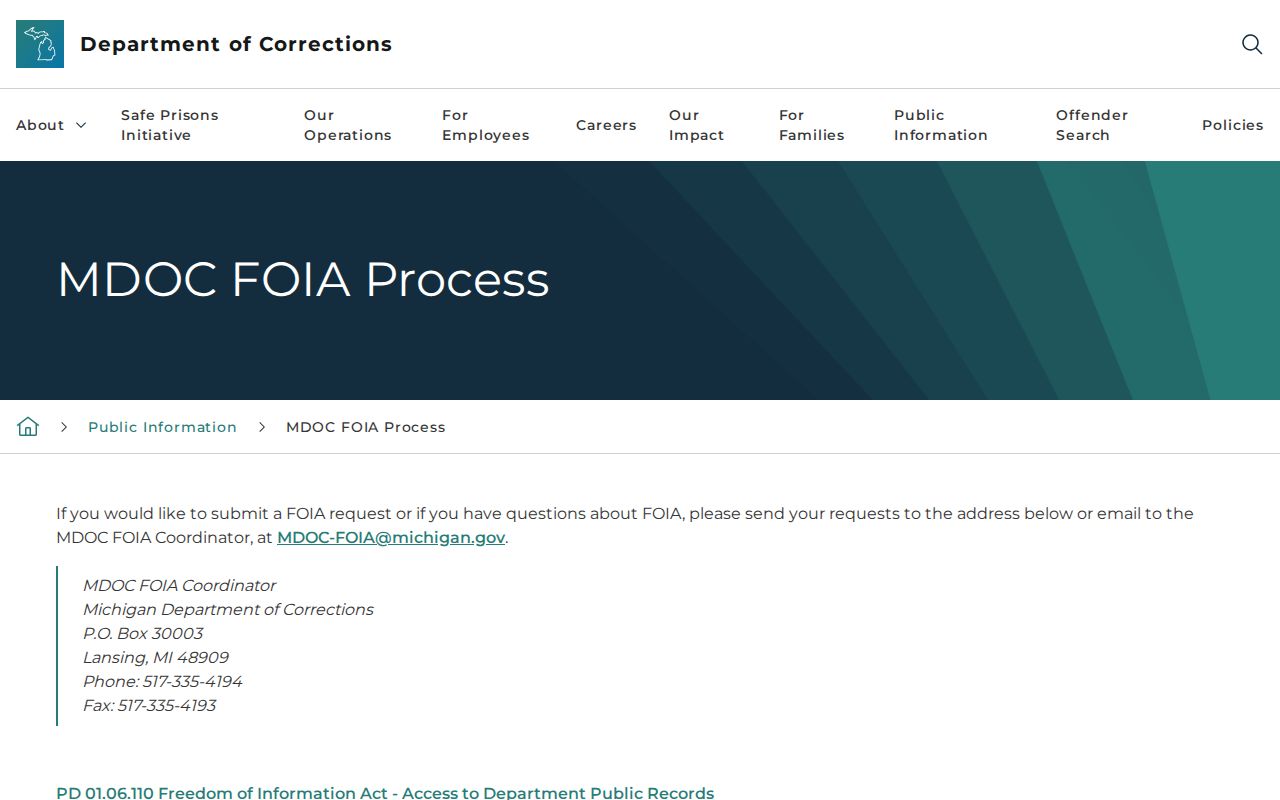
Use the published process to preserve the exact event and date rather than relying on a copied profile or an inference from a changed location.
MDOC FOIA Coordinator
P.O. Box 30003
Lansing, MI 48909
Email: MDOC-FOIA@michigan.gov
Phone: 517-335-4194
Fax: 517-335-4193
Kinross Prison Records Contact
The prison's official page confirms the institution, mailing location, public phone, email, operator, and security levels. Use the facility contact for local routing and current public information. For an individual parole, discharge, or time-computation record, OTIS and the central MDOC record contacts remain the correct sources. Facility staff may not provide protected case, medical, security, or supervision details.
Kinross Correctional Facility
4533 West Industrial Park Drive
Kincheloe, MI 49788
Phone: 906-495-2282
Email: mdoc-kinross-public@michigan.gov
Operator: Michigan Department of Corrections
Custody: Adult men, Levels I and II
The successful manifest capture presents the official Kinross Correctional Facility page.
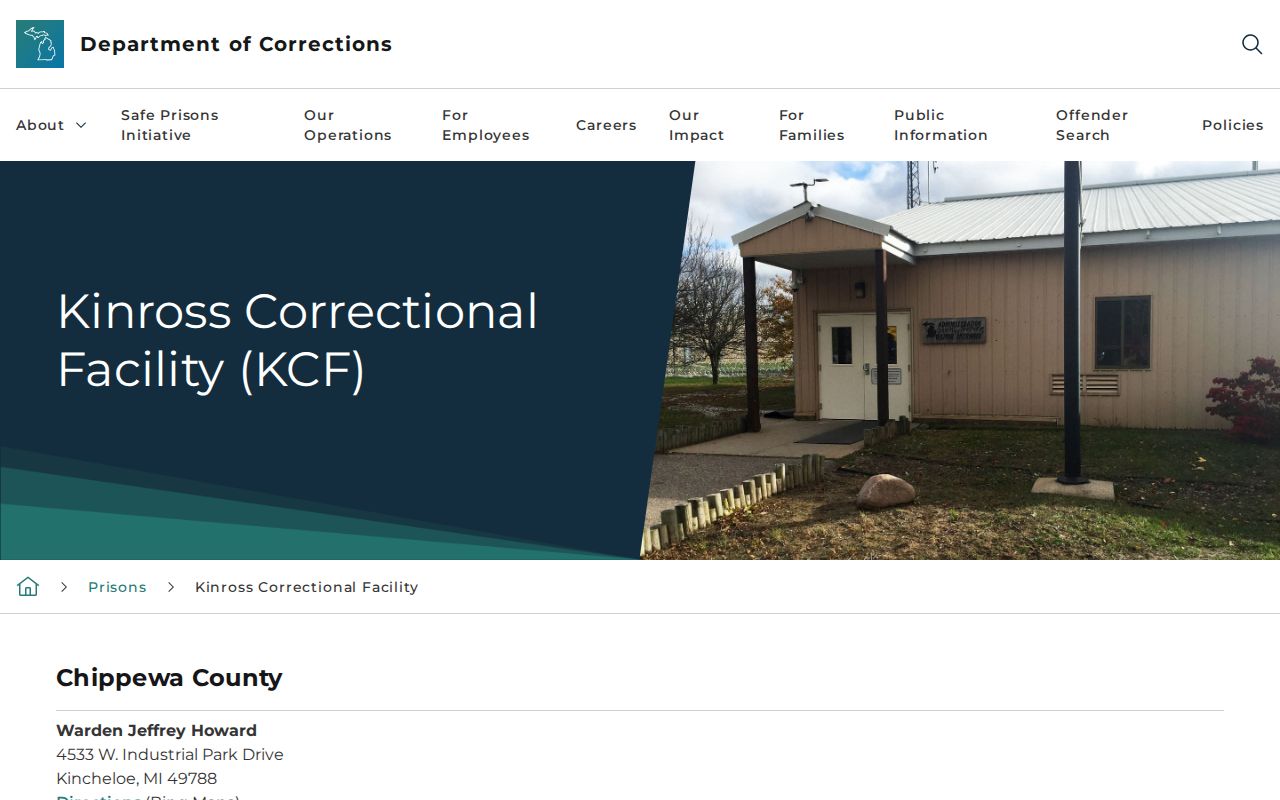
This institutional page verifies the facility identity. It is not an individual release roster, so it should be paired with the person's OTIS or MDOC record.
Kinross Release Location History
Kinross Correctional Facility relocated in October 2015 to the former Hiawatha Correctional Facility site. That history can explain why an older document uses a location name or address that does not match the current facility page. Resolve the person by MDOC number and dates, then compare the institution named at the time. Do not assume that a facility-name change marks release.
Chippewa County also contains Chippewa Correctional Facility, another active MDOC men's prison. The presence of two state prisons in Kincheloe makes short location references especially easy to confuse. A profile moving between Kinross, Chippewa, or an institution elsewhere in Michigan remains a prisoner profile unless the status itself changes to parole or discharge.
Facility history and custody history are related but distinct. The former tells where an institution operated. The latter records where a specific person was held and when MDOC jurisdiction changed. For a defensible timeline, preserve each dated location and the later custody-ending status as separate facts.
Note: A historic Hiawatha site reference can identify the present Kinross location without proving any individual release event.
Kinross Prison Transfer Signals
MDOC announcements about Chippewa County prison units show that capacity is operationally dynamic. Units may open or close, and residents may move to other units or facilities. Although the cited 2024 and 2026 announcements focus on Chippewa Correctional Facility operations, the lesson applies to reading a Kinross profile: a new prison location is a concrete transfer signal, not a release signal.
When OTIS changes from Kinross to another institution, record the new LOCATION and the date observed. Look for a separate PAROLE status and DATE PAROLED before calling the move a community departure. MI-VINE may also send a transfer alert. Preserve its exact wording. A transfer notification reports custody movement and cannot be converted into a release event.
If two sources disagree, compare their scope and time stamps. OTIS records MDOC status, while a notification service relays contributor events. Ask MDOC to resolve a disputed parole date or location. A short chronology prevents a later transfer update from being blended with an earlier eligibility or Board date.
Kinross Parole Release Record
The Michigan Parole Board decides parole for eligible MDOC prisoners. The Parole Board Jurisdiction Date shown by OTIS is the Earliest Release Date, or ERD. It is the first point at which the Board gains jurisdiction under the applicable sentence. It is not an appointment, a grant, or a promise that the person will leave Kinross on that day. Parole remains discretionary.
A positive Board action may be suspended before departure if new misconduct or adverse information arises. Placement development can also affect implementation. The Parole Release Unit documents a positive decision, the parole date, term, and conditions and helps coordinate placement. For a completed release, read the later OTIS PAROLE status and DATE PAROLED, then request the parole action when documentary detail is needed.
A maximum date answers another question. It is the potential sentence endpoint shown by MDOC, subject to applicable law and verified computation. Do not treat it as the parole date. Likewise, a later DISCHRG event may show the end of supervision rather than the earlier day the person left Kinross prison.
Note: A positive parole action can precede physical release and should not replace the later DATE PAROLED field.
Kinross Release Travel Planning
The Eastern Upper Peninsula Transportation Authority operates scheduled service between Sault Ste. Marie and Kincheloe. No cited source promises that Kinross Correctional Facility provides transportation, that the route stops at the prison door, or that service will align with an individual's departure. Keep travel plans separate from the proof of release.
After MDOC confirms a community release and effective date, check the EUPTA system information and current schedule or call 906-632-2898. Confirm the stop, accessibility needs, route date, and holiday service. A family member should not infer release merely because a route is available or because someone was expected to reach the ERD.