
Chippewa 72-Hour Feed Status
No official Chippewa County web page found in the research supplies a separate rolling three-day release list. The Sheriff Correctional Facility page provides jail operations and booking contacts, but no public roster, release tab, archive, update cadence, or online retention period. The Sheriff office page also has no verified 72-hour feed. A third-party recent-bookings page is not an official release record and cannot fill that gap.
This negative finding is important. A list of current detainees answers who remains at the jail, while a release log answers who left and why. A person can leave the Chippewa County building through community release, transfer to MDOC, another jail, or immigration custody. Those events require different follow-up systems.
Check Chippewa Three-Day Releases
The wider time span helps when the exact exit day is not known. Search each day in sequence and save the exact wording from every source. The goal is not to find any sign that the person disappeared. It is to identify the physical exit, legal basis, and next custodian.
- Use the official Chippewa County Sheriff app offender search and note the current agency, booking number, status, and dates shown.
- Search MI-VINE for a county custody event during the three-day span. Keep release and transfer labels separate.
- Review MiCOURT under the 91st District Court or 50th Circuit Court for bond, dismissal, sentencing, or other authority.
- Call 906-635-7620 and ask whether the jail processed departure during the defined range, under what disposition, and to whom.
- Request the existing release log or individual booking and release record under Michigan FOIA if written proof is needed.
The Chippewa County 24-Hour Release List narrows this sequence to a same-day event. Use the 72-hour range when the event may have crossed midnight or when a family learned about the change late. Neither range alters what counts as proof.
Note: Give the jail a clear start and end date, since “the last three days” changes with the time staff receive the question.
Chippewa Three-Day Record Fields
Chippewa County does not publish guaranteed web fields for a 72-hour list. A focused request may seek existing records that contain the fields below. Ask for releasable data and avoid demanding that staff create a new database or summary that the county does not keep.
| Requested field | Why it matters across 72 hours |
|---|---|
| Name and date of birth | Distinguishes people with similar names during the same period. |
| Booking number | Ties each event to one jail stay. |
| Booking date and time | Shows whether the custody began before the requested window. |
| Release date and time | Places the processed departure within the three-day span. |
| Release reason | Separates bond, time served, dismissal, completion, and other dispositions. |
| Receiving agency | Reveals a transfer to MDOC, ICE, or another jail. |
| Case and bond information | Connects the jail event to the controlling court matter. |
One form may not hold all these details. The county can grant, deny, or partly grant a request and can apply lawful exemptions. A release timestamp is more precise than a court order time. The court entry may explain legal authority, but a separate warrant or detainer can delay or prevent physical release.
Note: Request existing fields without assuming Chippewa County keeps every item in one release log or can create a new three-day report.
Chippewa Weekend Release Checks
A rolling three-day check often matters most after a weekend. Yet the research found no Chippewa County rule that promises a fixed weekend or holiday release schedule. It also found no official web cadence that would show when a release event enters the Sheriff app or MI-VINE. Do not assume a Monday search captures every event since Friday.
Create a brief timeline instead: court order entered, bond posted, holds checked, jail departure processed, VINE event sent, and any new custodian record created. These moments may fall on different days. If the app and MI-VINE disagree, ask the Sheriff about the physical county exit. For a signed legal order, ask the court. When MDOC accepts a transfer, OTIS may show the new prison location later.
Does a Friday release order guarantee a Friday exit? No. Booking staff still must complete release work and resolve holds. The county release sheet is the best source for the actual time.
Chippewa Tether Release Status
Not every move outside the secure jail is a complete end to program control. Chippewa County operates tether and work-release paths, and the Sheriff tether and work-release page describes the local program. A record should identify whether the person was released to the community without that control, placed on tether, assigned to work release, or transferred.
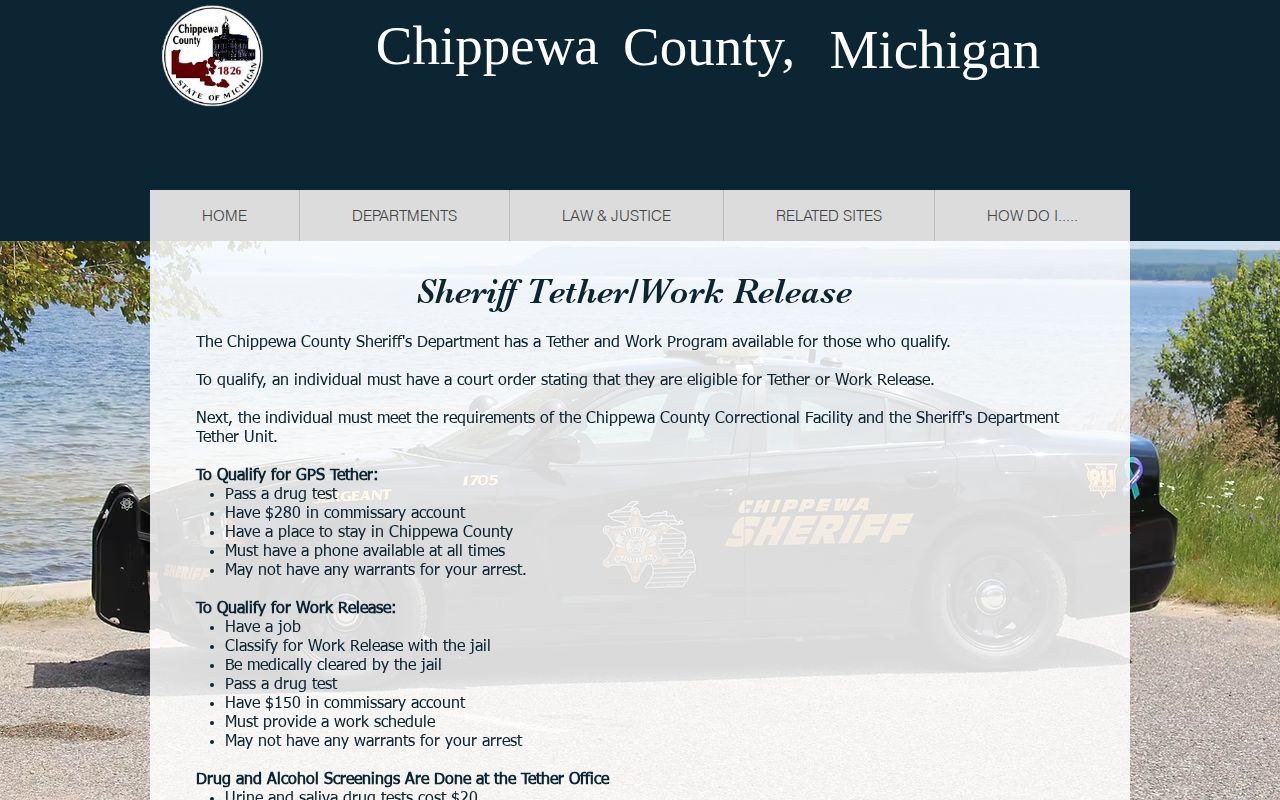
Tether is a monitored form of community placement. Work release permits approved movement for work under program rules. Neither term should be treated as proof that the full case, sentence, or supervision period ended. Ask which authority controls the placement and whether the person remains booked to the county program.
Note: A person outside the secure building may still be under county program control, so record the exact disposition rather than using “free.”
Request Chippewa 72-Hour Logs
A defined records request is the durable fallback for a multi-person window. Ask for an existing releasable log of departures from the Chippewa County Correctional Facility between two exact timestamps. Request release date and time, release disposition, and receiving custodian, while allowing protected fields to be removed. The county may not maintain the exact compilation, so the wording should also ask for the existing records from which those fields are kept.
The Chippewa County FOIA form may be emailed to kchurch@chippewacountymi.gov, faxed to 906-635-6325, or sent to the FOIA Coordinator, County Administrator, 319 Court Street, Sault Ste. Marie, MI 49783. Michigan FOIA does not require special wording, but the description must let staff find the records.
The county generally responds within five business days and may use one ten-business-day extension. Copies can cost up to $0.10 per sheet, labor is calculated in 15-minute increments, and a 50 percent deposit may be required when an estimate exceeds $50. A response date is not the same as a promise that all records will arrive that day. Ask for electronic delivery and an itemized estimate.
A request for one person should include the full name, date of birth, booking number if known, and approximate stay. Ask for the booking and release sheet, release disposition, and receiving custodian. That narrower description may be easier to locate than a countywide log. It also gives a clearer basis for matching the physical departure to a court case or VINE event.
Match Chippewa Release Custodians
A three-day search can include several custody systems. The county jail record is correct for a local detainee. OTIS is correct for a state prisoner, parolee, probationer under MDOC, or recent discharge. ICE and federal systems cover different populations. Using the wrong database can produce a false no-result.
| Record clue | Next source | Safe reading |
|---|---|---|
| Sheriff app record disappears | Jail, MI-VINE, MiCOURT | County display changed; release is not yet proved. |
| MI-VINE says transfer | Named receiving agency | Custody moved and did not necessarily end. |
| OTIS says PAROLE | OTIS profile and MDOC | Prison ended, but state supervision continues. |
| OTIS location changes | New MDOC facility | The person remains in prison custody. |
| ICE locator has no result | ICE ERO and immigration record | No result may reflect transfer, removal, lag, or release. |
The Chippewa County jail is also an ICE contract site. A detainee may leave the county building but remain in federal civil custody. Ask the Sheriff whether the record says “released to ICE,” then follow the immigration custodian. Never turn a local departure into a claim of community release without support.
Verify One Chippewa Release
A broad three-day list and a named-person search serve different needs. For one known person, exact identity data lets the jail, court, and notification records line up. Search the correct court, compare the booking or MDOC number, and record each agency’s event wording. The full Chippewa County release-record path covers county, state, federal, and immigration sources for that focused check.
If the person received time served, obtain the signed judgment and county release sheet. Time served can authorize release on one case without clearing another hold. If the person was bound over on a felony and later moved to MDOC, the county jail departure is a transfer. A future parole date is a separate event.
A no-result in OTIS does not settle a jail-only question. OTIS excludes people whose only confinement was in a county jail, and older discharged state records can leave the public display. Match the system to the custody event before drawing a conclusion.
For any mismatch, compare scope and timestamps first. The Sheriff owns the physical county exit fact, the court owns its order, MDOC owns state status, and VINE relays events contributed by agencies.