
Chippewa Mugshots and Public Records
A mugshot, also called a booking photograph, is made during an arrest or jail-booking event. It stays tied to that event after release. The photo does not show whether a charge was dismissed, a person posted bond, a sentence ended, or a transfer occurred. Those questions belong to the court disposition and release record.
The Michigan Attorney General’s FOIA resources include the state handbook’s discussion of sheriff booking photographs. That handbook treats a sheriff booking photo as a public record and explains that the law-enforcement-interference exemption requires actual interference, not a blanket label. Other valid exemptions can still apply, so access is not absolute.
Michigan FOIA begins at MCL 15.231 and following sections. MCL 15.243 contains exemptions. A request can be granted, denied, or granted in part, with releasable material separated from exempt material. Chippewa County has not stated a policy promising online publication of every booking photo.
The official Michigan Attorney General FOIA resource page is shown below.
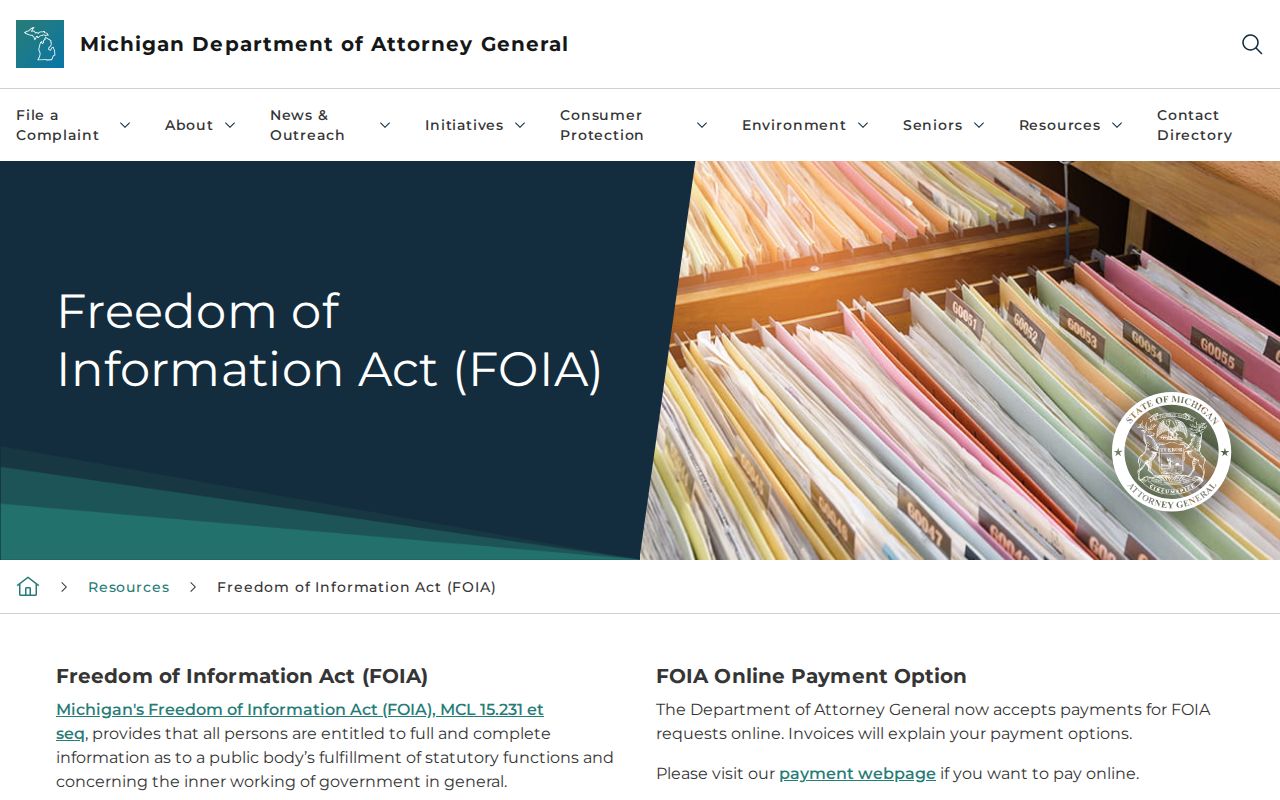
That state guidance supports a direct records request when no Chippewa County released booking photo is published online.
Chippewa Released Mugshot Channels
Each channel has a different scope. The Sheriff owns the county booking image. MDOC owns a state offender image. A registry photograph belongs to a special statutory system, while news and third-party copies are secondary. Do not substitute one source for another without naming what it is.
| Channel | Photo status | Access and limit |
|---|---|---|
| Sheriff website | No verified photo feed found | The county pages publish no official roster or recent-release gallery |
| Sheriff mobile app | Possible, not promised | The listing supports offender search; check the matched live record |
| County FOIA | Request the booking photo | Use name, DOB, booking number, and booking date when known |
| OTIS | May show an MDOC image | Applies only when the person has an MDOC record |
| VINELink | Depends on contributed data | Its main purpose is custody status and notification, not photo archiving |
| Michigan PSOR | Photo for published registrants | Special-purpose registry, not a general released-inmate source |
| News or third-party archive | May preserve a copy | Secondary and selective; verify source, event, and custody elsewhere |
An OTIS image may differ from a county booking photo in age, date, and purpose. The public profile may lack an image when a person left custody before electronic photography or was not photographed. The Michigan Public Sex Offender Registry is even narrower. It applies only to people legally required to register and should not be used as a general photo search.
VINELink has another limit. A matched record may display identifying material supplied by the contributing agency, but its core function is custody status and alerts. It is not a permanent photo archive. A release event can help corroborate a transition, while a transfer event points to a new custodian. Neither event turns an attached image into the official Chippewa County booking photograph.
Note: Label every image by agency and booking or record date; a historic photo does not establish current custody or appearance.
Chippewa Sheriff App Photo Check
Chippewa County has an official Sheriff mobile app for Apple devices and Android devices. The store description supports offender searches, and the Apple version history notes OTIS integration. Those facts make the app a reasonable first check for an offender record.
The listing does not promise that a released record stays visible, that a mugshot appears, or that records remain for a fixed number of hours. Only a live matched record can establish what was displayed at that time. Record the person’s identifier, source agency, status wording, and image context. If the app shows no image, use the county request path rather than assuming no booking photo exists.
Disappearance from the app is also inconclusive. The person may have been released, transferred, removed from a public display, or affected by a source update. Check MI-VINE for the exact event and read the 91st District or 50th Circuit court record for legal authority. The Sheriff’s release sheet remains the better proof of the processed county departure.
The official Chippewa County Sheriff app listing appears below.
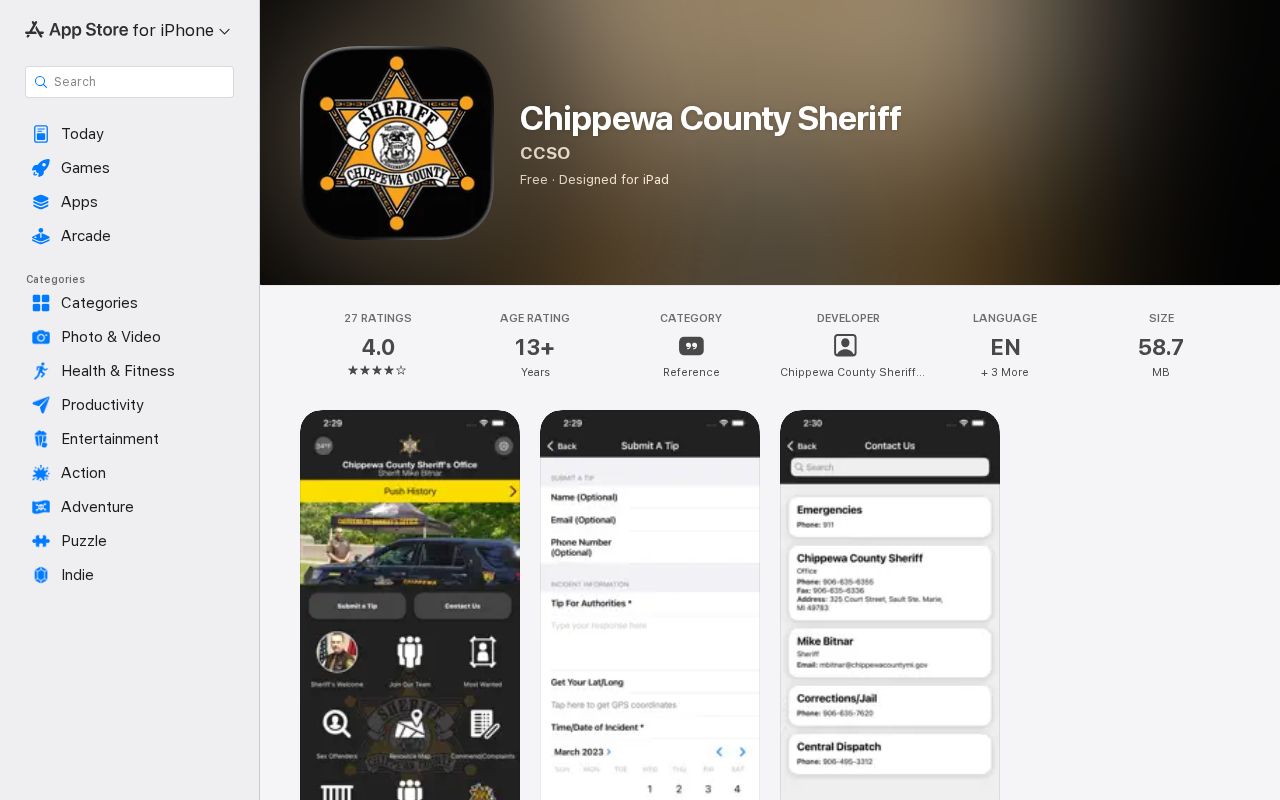
The listing proves an offender-search feature, but it does not prove a recent-release window or guaranteed booking photographs.
Request a Chippewa Booking Photo
A focused county FOIA request is the strongest durable path to a Chippewa County booking image. The request should identify the stay well enough for staff to find it and should ask for the photograph apart from the rest of the booking and release sheet. Michigan FOIA does not require special wording or a particular form, though the county supplies a form.
- Identify the full name, date of birth, booking number, and approximate booking date. Include only the facts needed to locate the event.
- Ask for the specific booking photograph in electronic form. If release verification also matters, separately ask for the booking and release sheet, release date and time, disposition, and receiving custodian.
- Send the request to the Chippewa County FOIA Coordinator by email at kchurch@chippewacountymi.gov, fax at 906-635-6325, mail, or delivery to 319 Court Street, Sault Ste. Marie, MI 49783.
- Ask the county to separate and release nonexempt material and to cite the statutory basis for any withheld part.
- Request an itemized estimate before costly work. Paper copies may cost up to $0.10 per sheet, and labor is calculated in 15-minute increments.
The county’s published summary says it generally responds within five business days and may use one extension of up to ten business days. A response is a decision, not necessarily production by that date. A deposit of 50 percent may be required when an estimate exceeds $50, and a qualifying indigence discount of $20 may apply.
MCL 15.234 governs permissible fees and deposits, while MCL 15.235 supplies the response framework. The Chippewa County release-record search explains how the photo fits with the jail exit record and court disposition.
Chippewa MDOC and Registry Photos
Use OTIS only when the person entered MDOC jurisdiction. Search by MDOC number when possible, or by exact name with enough identity facts to distinguish matches. A public profile can include a photograph, status, sentence data, and location. An OTIS photo is an MDOC offender image. It may not be the photograph made during a separate Chippewa County jail booking.
OTIS also has a limited public period for discharged records. MDOC says a discharge remains displayed for three years after supervision ends, subject to removal through set-aside, expungement, or law. An old no-hit can therefore reflect the display rule, an exact-name mismatch, a jail-only case, or legal record treatment. For an older state image, a focused MDOC records request is more sound than a copied archive.
The Michigan State Police registry information shown below explains the narrow registry context.
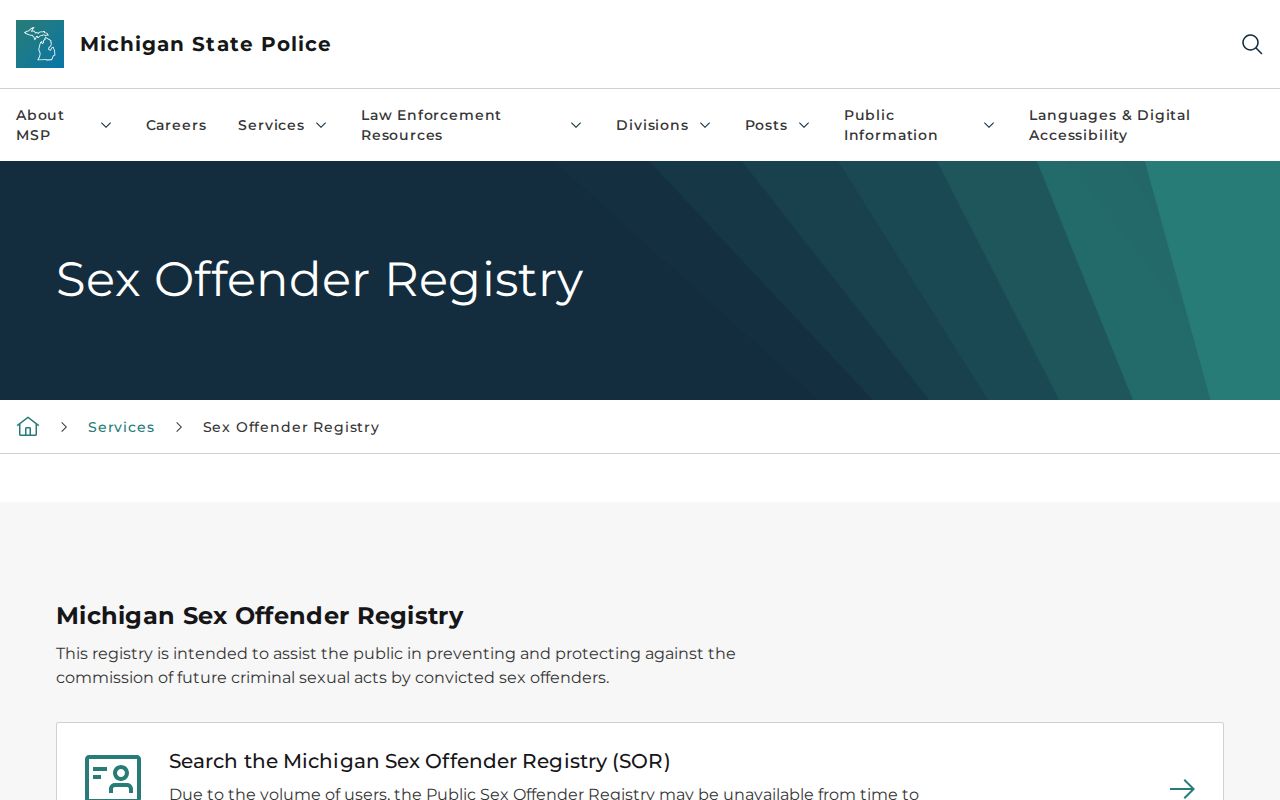
A registry image applies only to a person lawfully published there. It does not supply the county jail release time or replace the Sheriff’s booking photograph.
Chippewa Mugshots Beyond Agencies
Local news reports and official agency releases sometimes include a booking image when a case receives public attention. That publication is selective. It does not create a complete archive of Chippewa County releases, and an article’s date may differ from the arrest, booking, or release date. Read the caption and source before associating the image with an event.
Commercial archives and other third-party collections may also preserve copied images. They are not controlled by the Sheriff and cannot establish completeness, authenticity, or current status. No commercial mugshot publisher or removal service is linked here. When a secondary copy helps identify a possible booking, use the agency record, booking number, and court case to verify it.
Authenticity can also fail through simple context loss. A copied image may omit the agency, crop an identifying caption, or combine the photograph with a later story. Compare the face only after matching the name, booking or MDOC number, booking date, and source. If the image will be cited in a court or records matter, obtain the official copy and preserve the response that identifies it.
A photo must never carry more meaning than its source allows. Arrest is not a finding of guilt. A historic booking photo says nothing by itself about disposition, supervision, later set-aside, or whether the person is now confined. The release sheet and court register of actions answer those questions.
Chippewa Mugshots After Set-Aside
A set-aside or sealing order can change public access to the underlying case. Michigan’s conviction set-aside statutes begin at MCL 780.621. The Michigan State Police keeps a nonpublic record under MCL 780.623 after a set-aside. Public interfaces may stop showing material because of that legal treatment, not because a new release occurred.
No authoritative source in the Chippewa research establishes a statewide Michigan anti-pay-to-remove statute. That claim should not be made. A person seeking correction or removal should first identify who published the image. An official source should be given the relevant court order or record-correction basis. A news outlet or third party controls its own copy, subject to applicable law and policy.
Do not use cached or copied pages to defeat a lawful privacy restriction. If an agency withholds a photo, ask for the cited exemption and appeal information. The proper response is to respect sealed, juvenile, set-aside, confidential, and exempt material while still requesting any portion that remains public.
Note: A removed public image may reflect a legal order or display policy; it does not prove that the booking never occurred.