
Chippewa Prison Release Outcomes
Chippewa Correctional Facility is operated by the Michigan Department of Corrections in Kincheloe. It is not the Chippewa County jail. The state prison holds adult men at security Levels I, II, and IV. County Sheriff booking records do not establish when someone leaves this institution, and a county recent-release source would not cover an MDOC sentence.
A parole outcome means the person physically left prison while the sentence continued under MDOC and Michigan Parole Board jurisdiction. OTIS uses PAROLE for that status and lists DATE PAROLED as the prison-exit date. A DISCHRG status means MDOC jurisdiction ended for that sentence. Discharge must still be read in context because MDOC recognizes more than one route, including maximum discharge and death. A different prison location is an intra-MDOC transfer, not release.
| OTIS fact | What it means |
|---|---|
| PAROLE with DATE PAROLED | Left prison and remains under community supervision |
| DISCHRG | MDOC jurisdiction ended for that sentence; review the full history |
| New prison LOCATION | Continued MDOC custody at another institution |
| Future ERD | First parole-eligibility point, not a promised release |
Confirm Chippewa Prison Release
The MDOC Offender Tracking Information System, or OTIS, is the primary public route. It covers MDOC prisoners, parolees, many probationers supervised by MDOC, absconders, and discharged people during the public display period. It does not cover a person whose only confinement was at Chippewa County Correctional Facility. Choose the status filter with care because the default active-offender view can omit the discharged result being sought.
- Search by MDOC number when known, or use the exact last and first names with identity details.
- Select All or Discharged instead of relying only on Active Offenders.
- Open the correct match after comparing the MDOC number and date of birth or other lawful identifiers.
- Read STATUS with LOCATION, DATE PAROLED, the Parole Board Jurisdiction Date, and MAXIMUM DATE.
- Request an MDOC record if the status is unclear, sensitive, or outside the OTIS display period.
Text searches are exact, so spelling and aliases matter. A no-hit can reflect an old discharge, a set-aside or expungement, a search mismatch, or a person who was never in MDOC custody. It does not prove that no prison release occurred. The Chippewa County release search overview separates OTIS results from county jail and federal custody records.
Chippewa Prison Search Fields
OTIS accepts last name, first name, offender number, sex, race, age, offender status, and marks, scars, or tattoos. Status choices include prisoners, parolees, probationers, discharged people, and parole or probation absconders. Use only enough identity data to distinguish the correct record. Do not overpublish physical details that are not needed to verify custody or release.
The profile may show the MDOC number, identity information, status, controlling-sentence statute, supervising place or prison location, sentence dates, and a photograph. Some people who left before electronic photography or were not photographed may have no image. The most useful release fields are status and date paroled. The Parole Board Jurisdiction Date is the earliest release date, or ERD, when the Board first has jurisdiction. It is not a scheduled exit.
- Parole
- Release from prison into supervised service of the sentence in the community.
- Discharge
- The end of MDOC jurisdiction for the sentence, subject to the reason shown in the record.
- ERD
- The earliest point for Parole Board jurisdiction, not a guarantee that parole will be granted.
- Maximum date
- The potential maximum sentence date shown by MDOC, subject to applicable law and verified calculations.
Note: Probation is a court sentence and should not be mislabeled as a release from Chippewa Correctional Facility.
Chippewa Prison Release Records
OTIS is fast, but it is not the only official source. Discharged profiles generally remain public for three years after supervision discharge, including death, and then may be removed. A renewed supervision term can reset that period. Older or more detailed evidence may require MDOC Records Retention or a Freedom of Information Act request. Current Prisoner Records can be reached at Corr_Records_Info@michigan.gov. The advertised past-prisoner Records Retention contact is MDOC-Records_Retention@michigan.gov for assistance up to six years post-release.
Ask MDOC for the specified person's Basic Information Sheet and time computation, parole action or decision and date, parole release date, discharge date and reason, discharge certificate, and releasable offender photograph. Include the full name, date of birth, and MDOC number. Do not ask for a PENPACK as a public shortcut; MDOC limits that certified packet to recognized criminal-justice authorities conducting official business.
MDOC FOIA Coordinator
P.O. Box 30003
Lansing, MI 48909
Email: MDOC-FOIA@michigan.gov
Phone: 517-335-4194
Fax: 517-335-4193
For court-derived sentence data that appears wrong, contact the sentencing court. MDOC relies on court orders for those facts. For supervision information, use the office shown in the OTIS location field rather than assuming the Chippewa office controls the case.
Chippewa Prison Contact Record
The official prison page supplies the facility address, public phone, email, custody level, and operational description. Contact the prison for facility-specific routing, but use OTIS or MDOC records for a documented parole or discharge result. A facility employee may not be able to disclose protected details or predict a Board decision.
Chippewa Correctional Facility
4269 West M-80
Kincheloe, MI 49784
Phone: 906-495-2275
Email: mdoc-chippewa-public@michigan.gov
Operator: Michigan Department of Corrections
The official Chippewa Correctional Facility page is shown in the matched manifest capture.
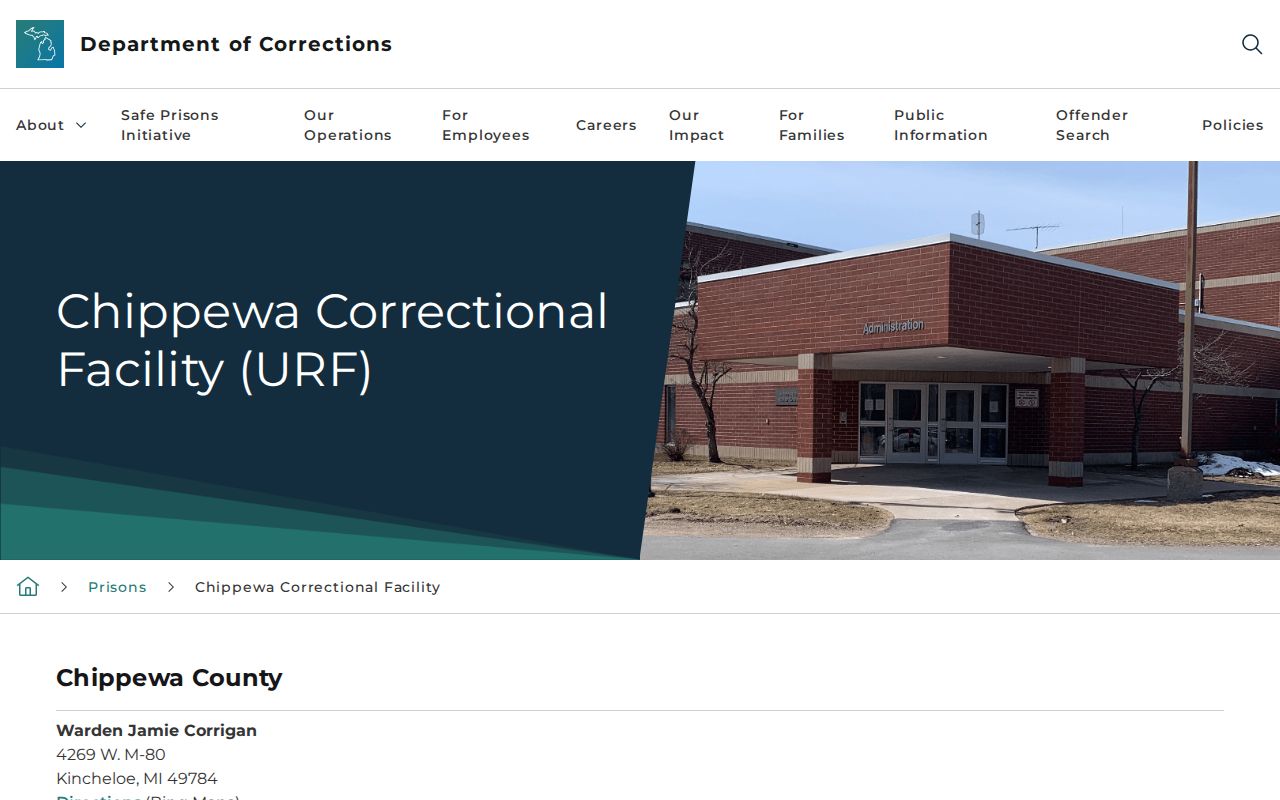
The prison page confirms which institution is involved. It does not serve as an individual release list, so return to OTIS and MDOC person records for status.
Chippewa Prison Transfer History
Chippewa Correctional Facility opened in 1989. More recent MDOC unit announcements show why operational history matters to a release search. A Level II unit reopened in 2024. In 2026, MDOC announced a temporary Level II unit closure and the relocation of residents to other units or facilities as part of a broader prison initiative. Those moves change where a prisoner is assigned without ending the sentence.
The successful manifest image captures the official 2026 MDOC unit announcement.
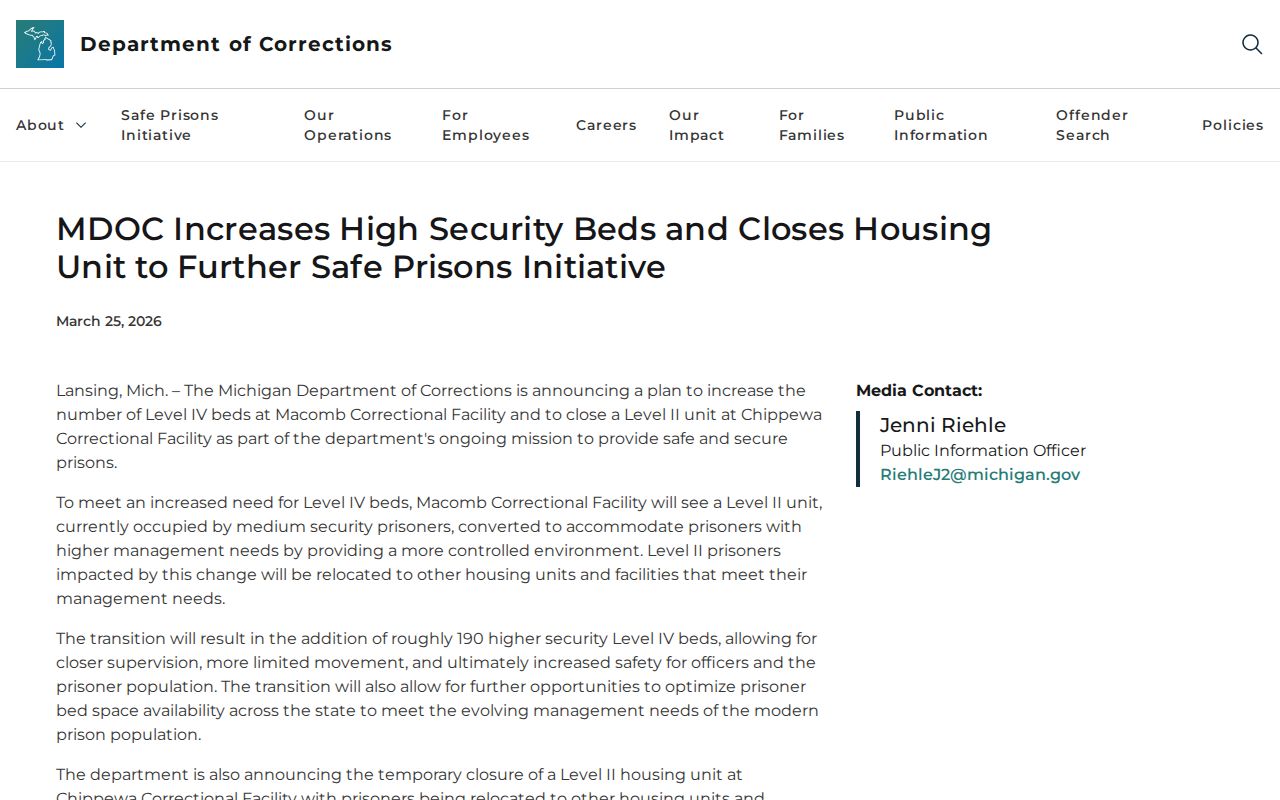
A changed unit, an absent unit listing, or a new MDOC facility is evidence of operations or transfer. Look for PAROLE, DATE PAROLED, or a supported discharge reason before reporting release.
Note: Preserve the old and new MDOC locations as transfer facts until a separate custody-ending status appears.
Chippewa Prison Parole Records
The Michigan Parole Board is the paroling authority for MDOC prisoners. Reaching the ERD does not itself release a person. Parole remains discretionary, and a positive action can be suspended before the physical departure if misconduct or other adverse information arises. The Parole Release Unit documents a positive decision, parole date, term, and conditions and coordinates placement. A decision, an implementation date, and the actual DATE PAROLED can therefore answer different questions.
Read OTIS after the planned date. A PAROLE status plus DATE PAROLED is the strongest public sign that the person left secure prison and remains supervised. LOCATION should then identify a supervising place rather than a prison. Do not call that status discharged. A later DISCHRG status may mark the end of supervision, not the date the person first left Chippewa Correctional Facility.
Chippewa Release Record Corrections
An OTIS profile draws some facts from the sentencing court and other facts from MDOC operations. That division determines where to seek a correction. If the disputed item came from a judgment, charge, or sentence order, contact the sentencing court that created it. MDOC updates court-derived data from court orders. A facility email cannot rewrite a judgment, and a public search user should not blend an expected sentence with the official calculation.
Questions about parole status, a supervising place, or an absconder code belong with the appropriate MDOC parole or probation office. The location shown on the individual profile controls the routing. The Chippewa County Parole/Probation office is not automatically responsible just because the prison is in this county. For a disputed DATE PAROLED, discharge reason, or time computation, request the underlying MDOC record and state the exact field that needs review.
Build a short record trail before asking for correction. Save the MDOC number, the observed status and date, the source URL, and any relevant signed court order. That lets the record owner compare like facts. It also prevents a court order date, Board decision date, planned release date, and physical prison-exit date from being treated as one event.
Note: The office that created a disputed fact is the best source for a correction or certified record.
Chippewa Release Travel Limits
EUPTA operates scheduled public transportation between Sault Ste. Marie and Kincheloe. The source does not state that Chippewa Correctional Facility supplies a ride, guarantees a prison-door stop, or coordinates the route with a particular release. Transportation planning should begin only after MDOC confirms community release and the effective date.
Check the EUPTA bus system information or call 906-632-2898 to confirm the current stop, schedule, accessibility needs, and holiday service. Do not use a bus plan as evidence that parole occurred. The custody record remains the source for release, while the carrier supplies current travel information.