
Chippewa Scheduled and Actual Release
A projected or eligibility date is a calculated point in a sentence. It may mark when a prisoner first reaches Parole Board jurisdiction, when a maximum term could end, or when probation supervision is due to end. None of those fields proves that the person walked out on that date. The actual release record identifies the processed departure and whether it was parole, discharge, transfer, or another event.
A pretrial detainee at Chippewa County Correctional Facility usually has no computed prison release date. The 91st District Court may set bond or enter another release order, but a warrant, detainer, or second case can still block departure. Jail staff must finish the release process. A person sentenced to county jail needs the judgment, jail-credit calculation, and sheriff release record. State-prison dates belong to MDOC and OTIS, not the county jail.
The same rule applies when a location changes. Chippewa County contains two active MDOC prisons. A move from Chippewa Correctional Facility to Kinross Correctional Facility, or to another prison, is a transfer within custody. It is not a release even though the first location no longer holds the person.
Find a Chippewa Projected Release
Begin by naming the custodian. The OTIS offender search covers MDOC prisoners, parolees, many felony probationers, absconders, and recent discharges. It excludes people whose custody is only in a county jail. Exact names can miss a match, so an MDOC number is best when available.
- For an MDOC prisoner, search OTIS by offender number or exact name. Use age and other lawful identity facts to distinguish records.
- Read STATUS and LOCATION first. A prison status means the person remains confined even if future dates appear.
- Locate the PAROLE BOARD JURISDICTION DATE, also called the Earliest Release Date, and the MAXIMUM DATE. Keep their meanings separate.
- Check the sentencing court in MiCOURT for a corrected judgment, consecutive sentence, or jail-credit order that may explain the computation.
- For a county-jail sentence, ask the Sheriff for the jail-credit calculation and release record. Do not apply OTIS date rules to a jail-only term.
- When precision matters, request MDOC’s Basic Information Sheet and time computation or the county jail’s actual release sheet.
OTIS search fields include last and first name, offender number, sex, race, age, status, and marks, scars, or tattoos. Status choices include prisoners, parolees, probationers, discharged people, and parole or probation absconders. The identity should be checked before any date is attributed to a person.
| OTIS field | What it answers | What it does not prove |
|---|---|---|
| Status and location | Current MDOC category and listed place | Why a facility transfer occurred |
| Parole Board Jurisdiction Date | Earliest point for Board jurisdiction under the applicable sentence | A scheduled day of release |
| Maximum date | Potential maximum under the displayed computation | That parole will be denied until then |
| Date paroled | Date the person actually left prison on parole | The later end of supervision |
Chippewa ERD Is Not Release
Michigan’s distinctive public field is the Parole Board Jurisdiction Date. The OTIS field glossary defines it as the Earliest Release Date, or ERD. It is the first point at which the Board has jurisdiction under the applicable sentence. It is not an appointment, automatic release, or promise that a person will leave prison.
Context changes the meaning. For a probationer, the ERD column functions as the supervision release date. For a prisoner, it is tied to parole eligibility. A maximum date is different again. MDOC describes that field as the potential maximum with available legacy credits considered. If parole is not granted, confinement can continue until maximum discharge, subject to the official computation.
The official OTIS About page shown below provides the Michigan status and date glossary.
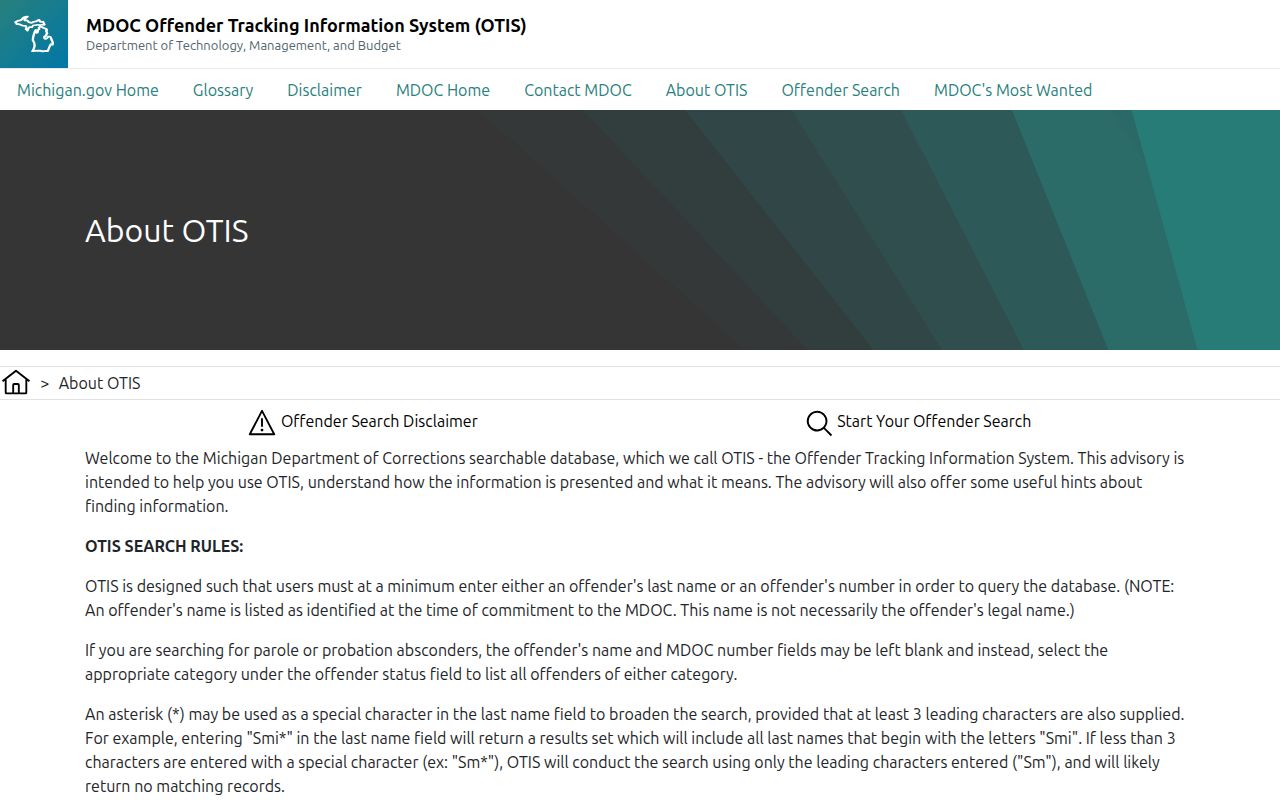
Read the ERD, maximum date, status, location, and date paroled together. One field alone cannot establish the present custody outcome.
Note: A future ERD means the first Board-jurisdiction point has not arrived; it does not create a fixed release appointment.
Chippewa Release and Michigan Credits
Michigan is not an “85 percent” shortcut state for the modern truth-in-sentencing cases described by MDOC. The MDOC parole consideration process says prisoners subject to truth in sentencing cannot use good-time or disciplinary credits against the judicial minimum. They generally must serve the full minimum before parole eligibility. The framework applies to specified assaultive crimes committed on or after December 15, 1998, and other crimes committed on or after December 15, 2000.
MCL 791.234 distinguishes disciplinary-time prisoners from legacy cases. Subsection 1 addresses Board jurisdiction after the court minimum less applicable legacy credits. Subsection 2 requires a disciplinary-time prisoner to serve the minimum. Consecutive sentences can combine minimum and maximum terms, and some life sentences are not parole eligible. Parolable life terms have separate rules and exceptions.
Older credit questions require the offense date, sentencing law, sentence structure, misconduct history, and exact credit type. MCL 800.33 addresses legacy good time and disciplinary credits, while MCL 800.34 addresses disciplinary time. These rules do not support subtracting a flat percentage from a sentence.
The official truth-in-sentencing explanation is captured below.
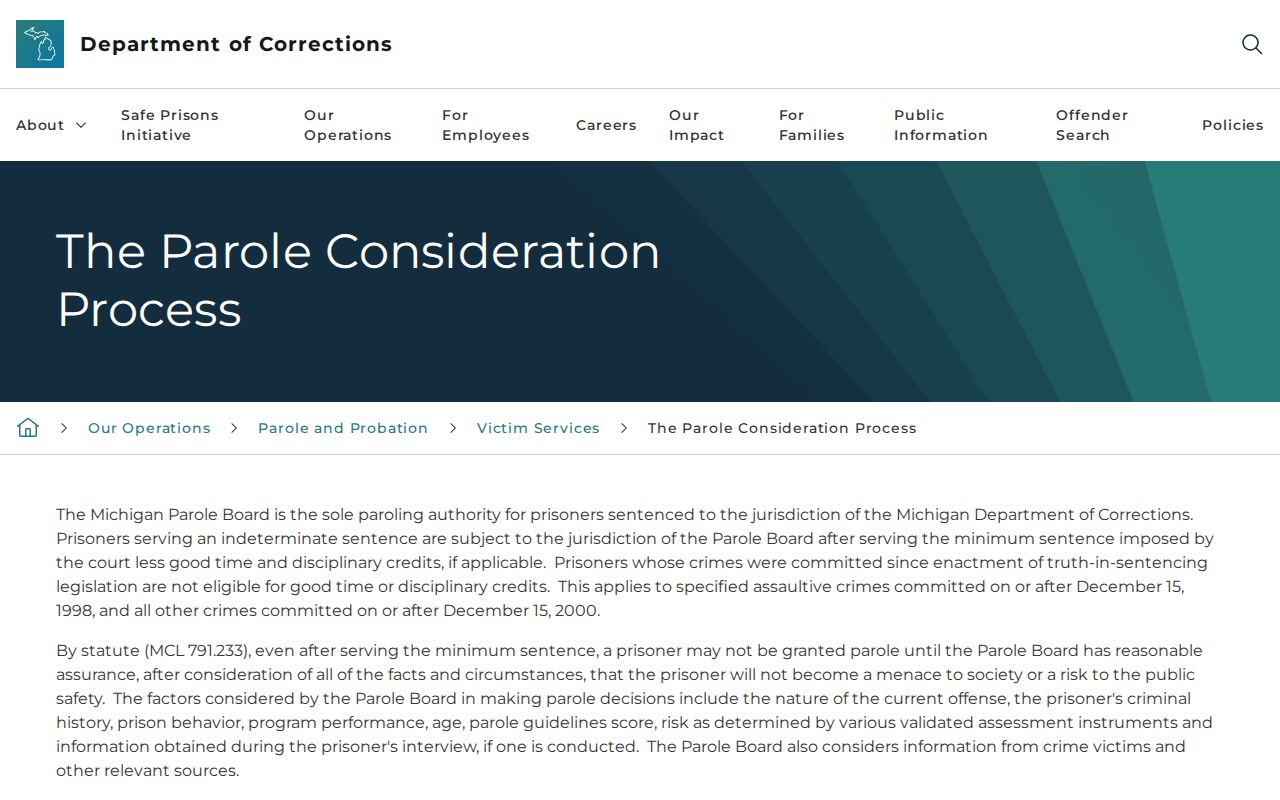
Its full-minimum rule is why a generic percentage calculation can produce a false Chippewa County projected release date.
Why Chippewa Release Dates Change
An official computation can change for a valid reason. Compare the new date with the court judgment and MDOC record before guessing. MDOC is the authority for state-prison time calculations, while the sentencing court must correct court-derived facts.
| Factor | Possible effect | Best record |
|---|---|---|
| Corrected judgment or jail credit | Changes the sentence input or credited time | Sentencing-court order and MDOC computation |
| Consecutive sentence | Aggregates minimums or maximums | Judgments and Basic Information Sheet |
| Legacy credit loss or adjustment | May move an eligible legacy calculation | MDOC time computation |
| Detainer or warrant | May cause transfer or block community departure | Release sheet and receiving-custodian record |
| Parole grant, denial, or deferral | Changes whether release follows eligibility | Parole action and later OTIS status |
| Adverse information after action | A positive action may be suspended | Parole Board or MDOC record |
The Board applies the standard in MCL 791.233 and considers the institutional record, conduct, risk information, interview, and other relevant material. Reaching ERD opens the legal decision point. It does not dictate the result. A placement plan can also affect when a favorable action is carried out.
Chippewa County Jail Release Dates
No Chippewa-specific jail good-time formula or weekend-release rule was found in the county sources. MDOC’s ERD and disciplinary-time rules must not be carried over to a county sentence. Ask for the signed commitment or judgment, the jail-credit calculation actually used, and the Chippewa County Correctional Facility release record.
A bond order is also not a fixed exit time. The order authorizes a path to release, but bond must be posted when required and all holds must be cleared. The Sheriff then processes the departure. A jail record should identify the effective release date and time, disposition, and whether the person went to the community or another custodian.
A sentence of time served has the same need for a custody check. It supplies authority to release on that case, but another warrant, probation hold, immigration detainer, or receiving-agency transfer may remain. Compare the signed judgment with the release sheet. If the county exit was a transfer to MDOC, the Sheriff’s date marks the end of the jail stay, not the start of freedom. OTIS may then show a prison location after state intake.
Chippewa felony records may also cross courts. The 91st District Court handles arraignment and preliminary stages. A bound-over felony continues in 50th Circuit Court. Search both parts of the MiCOURT trail when one docket stops before final disposition. The circuit judgment may contain the prison sentence or probation order that explains what happened after the county booking.
For a pretrial or jail-sentenced person, the Chippewa County release-record path combines the Sheriff app, MI-VINE, court record, jail contact, and a focused county FOIA request. OTIS becomes relevant only if the person separately enters MDOC custody or supervision.
Confirm Chippewa Actual Release
A planned date should be rechecked near the event. MI-VINE can report a release or transfer event from participating county sources and a general release event for MDOC prisoners. It is a notification tool, not a permanent release archive. A transfer alert means custody changed and should not be labeled community release.
The Michigan VINELink inmate check explains how to match one person and register for a notice. For documentary proof, ask MDOC for a Basic Information Sheet, time computation, parole action, parole release date, or discharge certificate. Current Prisoner Records and MDOC FOIA are the state routes; the Sheriff and court are the routes for a jail-only case.
OTIS usually displays discharged records for three years after supervision ends. An older no-hit may reflect that display period, exact-name search trouble, or legal record treatment. It does not prove the person was never in MDOC custody. When dates conflict, build a short timeline of the order, computation, Board action, release processing, and status update, then ask the agency that owns the disputed fact.
A state records request can name the exact items needed: the Basic Information Sheet, official time computation, parole action or decision, parole release date, and discharge date or reason. Include the person’s full name, date of birth, and MDOC number. Requests may be sent to MDOC-FOIA@michigan.gov, faxed to 517-335-4193, or mailed to the MDOC FOIA Coordinator, P.O. Box 30003, Lansing, MI 48909. For an active prisoner, Current Prisoner Records uses Corr_Records_Info@michigan.gov. The advertised past-prisoner Records Retention contact serves records up to six years post-release at MDOC-Records_Retention@michigan.gov. These contact windows differ from the three-year OTIS public display rule.
When two systems disagree, compare their scope and timestamps. A court shows legal authority, the jail records physical county custody, and OTIS records MDOC jurisdiction. Make a timeline rather than blending the dates. The order may come first, followed by jail processing, a transfer, and a later OTIS status change. The agency that created each event should resolve that event.
Note: Use MDOC for a prison computation, the Sheriff for county-jail exit time, and the court for the controlling judgment.