
Chippewa Parole and Probation Compared
Parole follows a state prison term. The Michigan Parole Board authorizes it, and the Michigan Department of Corrections Field Operations Administration supervises it. A person on parole has left prison, but the sentence is still active in the community. Probation is a sentence imposed by a court instead of, or sometimes after, confinement. Many felony probationers are supervised by MDOC, while the 91st District Court has its own probation operation for cases within its authority.
The distinction matters in Chippewa County. An OTIS status of PAROLE supports release from an MDOC prison to supervision. A PROB status identifies probation and does not by itself show a prior prison release. The sentencing court remains central to probation because its order sets the terms. Neither status means the case has ended.
| Point | Parole | Probation |
|---|---|---|
| How it begins | Release from an MDOC prison by parole action | Sentence or order from the court |
| Main authority | Michigan Parole Board and MDOC | Sentencing court; MDOC may supervise felony probation |
| Public record | OTIS may show PAROLE, date paroled, and supervising location | OTIS may show PROB; the court record supplies the order |
| End point | Discharge from MDOC jurisdiction or maximum discharge | Court or MDOC discharge after the probation term |
Basic terms help keep the records straight.
- Parole
- Serving part of a prison sentence under community supervision.
- Probation
- A court-ordered sentence supervised in the community.
- Discharge
- The end of MDOC jurisdiction for the sentence shown.
- Absconder
- A person who failed to remain in contact as required and is still subject to enforcement.
Verify Chippewa Post-Release Supervision
The official starting point is the MDOC Offender Tracking Information System, known as OTIS. It covers MDOC prisoners, parolees, many felony probationers, absconders, and discharged people during its public display period. It does not cover every county-jail-only case. Search exact names with care because OTIS says its text searches are exact. An MDOC number is the strongest key when one is known.
- Choose All, Parolees, Probationers, or the relevant absconder option instead of relying only on Active Offenders.
- Enter the MDOC number, or use the exact name with age and other lawful identity facts to separate matches.
- Open the profile and read STATUS together with LOCATION. A Chippewa-area office name is useful only when it belongs to the correct person.
- For parole, compare DATE PAROLED with the status. That field is the prison exit date, while a later discharge date answers when supervision ended.
- For probation, check the sentencing court in MiCOURT Case Search. The docket may show the sentence, violation action, and later orders.
- Contact the listed supervision office or sentencing court when the public status is unclear, appears wrong, or must be documented for a legal matter.
A county jail exit and state supervision answer different questions. The sheriff release record establishes when Chippewa County Correctional Facility custody ended. OTIS establishes whether MDOC jurisdiction or supervision exists. A person may have a county release without any OTIS record, or may leave the county jail by transfer into MDOC prison custody.
Note: Match an MDOC number, case number, or date of birth before treating a public supervision result as the correct person.
Chippewa Supervision Office Details
The MDOC Region 1 directory identifies the local state office. Contact it after checking OTIS, especially when a public location or status needs clarification. Staff may confirm public routing facts, but confidential conditions, home information, and case management details are not promised for public release.
Chippewa County Parole/Probation
Michigan Department of Corrections
325 Court Street, Suite 102
Sault Ste. Marie, MI 49783
906-635-6345
The 91st District Court probation office is separate, even though both operations are in the Court Street complex. Start with the court when the judgment came from the district court and OTIS does not show state supervision. For a felony bound over to 50th Circuit, use that court’s record to identify the sentence and supervising authority.
Do not choose an office from geography alone. OTIS LOCATION controls the public state-supervision assignment for the individual record, and a court judgment controls a court probation case. A person tied to Chippewa County may be supervised elsewhere. Likewise, the Court Street address does not merge the MDOC and district-court operations into one agency.
The screenshot below comes from the official Region 1 office directory.
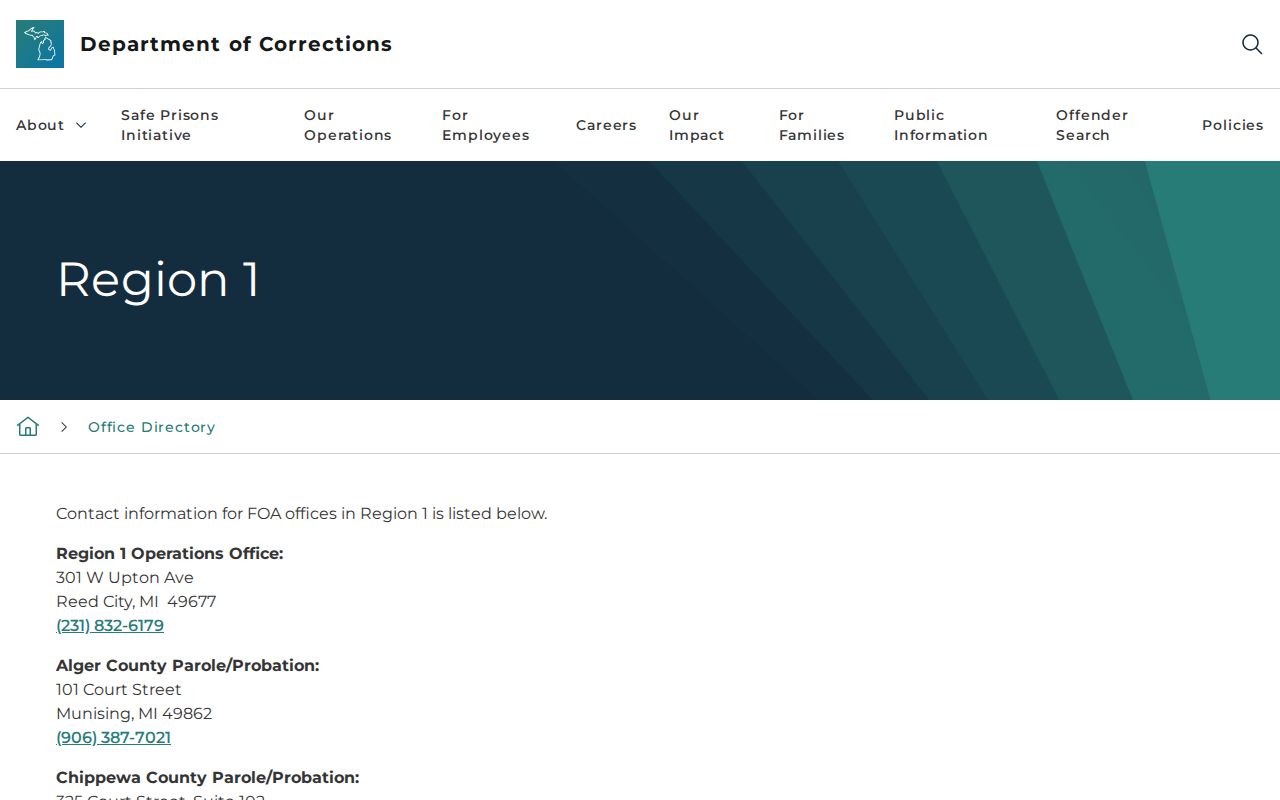
Its Chippewa County entry provides the local contact route that should be matched against the location shown in the individual OTIS profile.
Chippewa Supervision and Absconders
Supervision conditions come from the controlling parole order or probation judgment. They may address reporting, travel, approved programs, or other conduct, but a public profile does not disclose every term. A suspected violation does not itself prove revocation. The supervising authority must decide the response, and a court or MDOC record supplies the formal action.
OTIS uses two important codes. ABSCOND1 means a parole absconder actively sought by MDOC for failure to report. ABSCOND2 means a probation absconder whose case remains under the sentencing county’s jurisdiction. Both indicate unresolved supervision. Neither means the person was discharged. MDOC publishes an Absconder/Escapee Tip Line at 517-755-0855 for information about a listed person.
The 91st District Court probation FAQ describes a different local path. Failure to attend a show-cause proceeding may lead to a bench warrant that stays open until resolved. Check the court record for that warrant rather than converting a district-court issue into an MDOC parole label.
Chippewa Parole Decision Records
The Michigan Parole Board is the paroling authority for MDOC felony prisoners. Under MCL 791.233, release depends on the Board’s statutory standard. Eligibility is addressed by MCL 791.234. Eligibility does not guarantee release. A positive action may be suspended before the person leaves prison, and placement work may delay its use.
Michigan does not offer a public database of every ordinary granted, denied, or deferred parole decision. The public-hearing registration page carries rolling notices for proceedings that are public, including some clemency matters. It is not a complete calendar of ordinary parole interviews. The MDOC press archive can carry the same public notices, but it is not a person-by-person results search.
The official Michigan Parole Board page shown below explains the Board’s role.
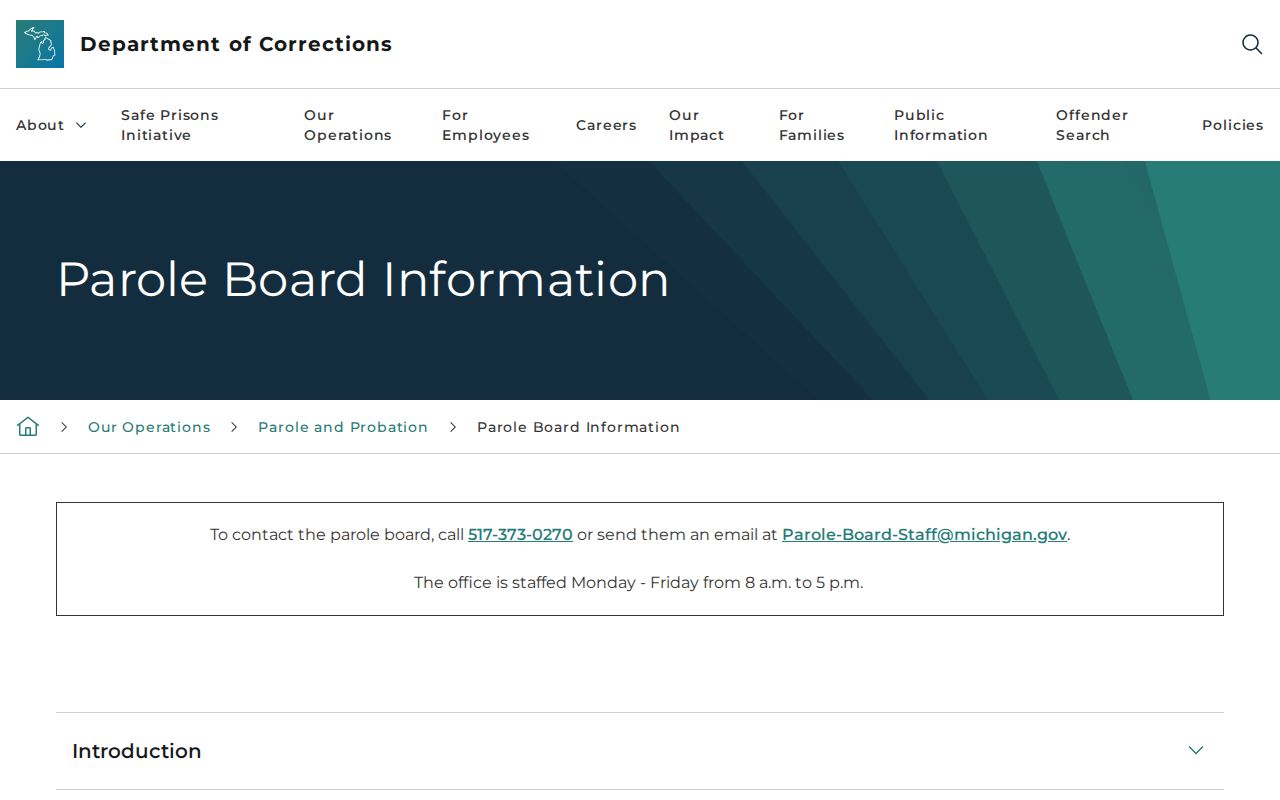
For one released person, OTIS status and date, Board correspondence, registered notification, or a focused MDOC records request are more direct than a public-hearing list.
Chippewa Release Notification Limits
MI-VINE serves a different purpose from OTIS. The Michigan VINELink portal can report participating county-jail events such as release, transfer, and escape. For MDOC prisoners, the official program describes a general release notification. A transfer message does not mean the person entered the community, and a release alert does not establish that parole supervision has ended.
VINELink is useful when a person is still confined and a future custody change matters. It is not a complete history of Chippewa County parole or probation. A no-result does not prove discharge. For a supervision question, use OTIS status, the sentencing court, and the office listed for that person. Direct victims seeking Michigan parole-hearing and decision notices must register separately with MDOC’s Crime Victims Notification Unit at 1-877-886-5401.
Phone registration in MI-VINE uses a four-digit PIN. The recipient listens to the automated event description and enters the PIN followed by the pound sign to acknowledge it. Without acknowledgment, calls may repeat for up to 72 hours. That time period concerns repeat calls, not a three-day release list or a supervision term.
The source and wording of an event control its meaning. Write down the agency, identifier, effective time, and exact event. For an urgent or legal need, confirm the fact with the Sheriff, MDOC, or court that owns the record.
Chippewa Supervision Discharge Records
Parole or probation ends through a formal discharge, not merely because the person stops appearing at an office. OTIS uses DISCHRG when MDOC jurisdiction for the displayed sentence has ended. The full record still needs context. MDOC’s glossary recognizes successful discharge from parole or probation, maximum discharge without parole, and death before sentence completion among routes associated with discharge status. A discharged result should not be described as a return home unless another source supports that fact.
OTIS generally keeps a discharged record public for three years after supervision discharge. If the record no longer appears, that public display limit is not proof that no official record exists. MDOC Records Retention or the MDOC FOIA process can be used for a Basic Information Sheet, parole action, release date, or discharge certificate. Court orders should be obtained from the sentencing court.
Michigan FOIA, MCL 15.231 and following sections, does not make all supervision details public. Confidential supervision, victim, medical, investigative, and security facts may be withheld under an applicable exemption. A focused request should ask for releasable portions and the statutory reason for any denial. For the broader county release path and record distinctions, use the Chippewa County released-inmate search.
Note: A parole date marks prison exit, while a later discharge date marks the end of MDOC jurisdiction for that sentence.