
County Facility Release Destinations
Chippewa County Correctional Facility is the local Sheriff-operated jail and an Immigration and Customs Enforcement contract site. Those two roles create several possible outcomes. A person held on a local case may leave after bond, dismissal, time served, or completion of a county sentence. Court-approved tether or work release can also move someone outside the secure building while restrictions continue. A warrant, detainer, prison commitment, or request from another jail can instead produce a transfer. The county stay ends in each example, but only some are community releases.
The release record should state the disposition and receiving custodian. That detail matters more than the fact that a person no longer appears in a Sheriff-facing source. A transfer to the Michigan Department of Corrections begins state prison custody. A handoff to ICE begins or continues federal civil detention. A move to another county leaves the person confined. When the destination field is unclear, ask the jail whether the person was released to the community or transferred to a named agency.
Confirm County Facility Release
No official Chippewa County webpage publishes a live roster, booking archive, or recent-release list. The Sheriff mobile app supports offender searches, but its store listing does not establish a release window, record-retention period, or full set of status fields. Confirmation therefore uses several records that answer different parts of the question. The jail record supplies the processed exit. A court entry may show why release was authorized. MI-VINE may report a release or transfer event, while the Sheriff app may show the source system's current state.
Use identity details before attributing any event. Match the full name with a booking number, date of birth when lawfully shown, and court case number. Common names and spelling differences can create false matches or missed results.
- Check the official Sheriff app and record the exact agency, status, identifier, and date displayed.
- Search Michigan VINELink for the same person. Preserve whether the event says release or transfer.
- Search MiCOURT in the correct Chippewa court for bond, dismissal, sentence, or later orders.
- Call the jail and ask for the exit date, release disposition, and receiving custodian.
- Request the booking and release record when written proof is needed.
The broader Chippewa County released inmate search explains how the county, MDOC, federal, and court systems fit together. Keep the sources separate when building a chronology.
Note: Match the booking number and case number before treating two custody events as records for the same person.
County Facility Release Records
A focused Michigan Freedom of Information Act request is the durable route when a phone answer or changing app display is not enough. Send the request to the Chippewa County FOIA Coordinator by email at kchurch@chippewacountymi.gov, by fax at 906-635-6325, or by mail or delivery to the County Administrator at 319 Court Street, Sault Ste. Marie, MI 49783. The county FOIA page provides procedures, and the county also publishes a request form. Michigan law does not require special wording, but the description must let staff find the record.
Name the person, date of birth, booking number if known, and an estimated stay date. Ask for the booking and release sheet, booking and release date and time, disposition, receiving custodian or transfer destination, charge and bond information, and booking photograph. Describe these as requested fields, not guaranteed fields. Juvenile, medical, victim, investigative, security, sealed, or other exempt material may be withheld. A partial response should separate and release material that is not exempt.
| Requested field | What it can establish |
|---|---|
| Release date and time | When Sheriff processing ended |
| Release disposition | Bond, time served, sentence completion, or another stated result |
| Receiving custodian | Whether the exit was a transfer rather than community release |
| Booking and case numbers | Links the jail stay to the correct person and court matter |
The county generally makes its FOIA response decision within five business days and may take one extension of up to ten business days. That period governs the response decision, not guaranteed record delivery. Fees can include labor in 15-minute increments and paper copies up to $0.10 per sheet. A 50 percent deposit may be required when an estimate exceeds $50. Ask for electronic copies and an itemized estimate.
Note: A court order can authorize release before jail staff finish processing holds and the physical departure.
County Facility ICE Departures
Official ICE material identifies the county jail as an intergovernmental service agreement detention site that can hold people for more than 72 hours. That status makes an ICE check essential when the person was held on an immigration matter or had an immigration detainer. Removal from Sheriff data might reflect transfer to another ICE site, removal from the United States, release under an order of supervision, protected data, or a reporting lag. None should be inferred from a blank result.
Start with the ICE Online Detainee Locator System. Search with the A-number and country of birth when available, or use the biographical name, date of birth, and country fields. A no-match is not a release certificate. Follow with the responsible Enforcement and Removal Operations office if the result is absent or unclear. The county release sheet may provide the key phrase, such as released to ICE, that proves the county exit was a handoff.
The successful manifest capture shows the official EOIR Automated Case Information portal, which reports immigration-court proceedings.
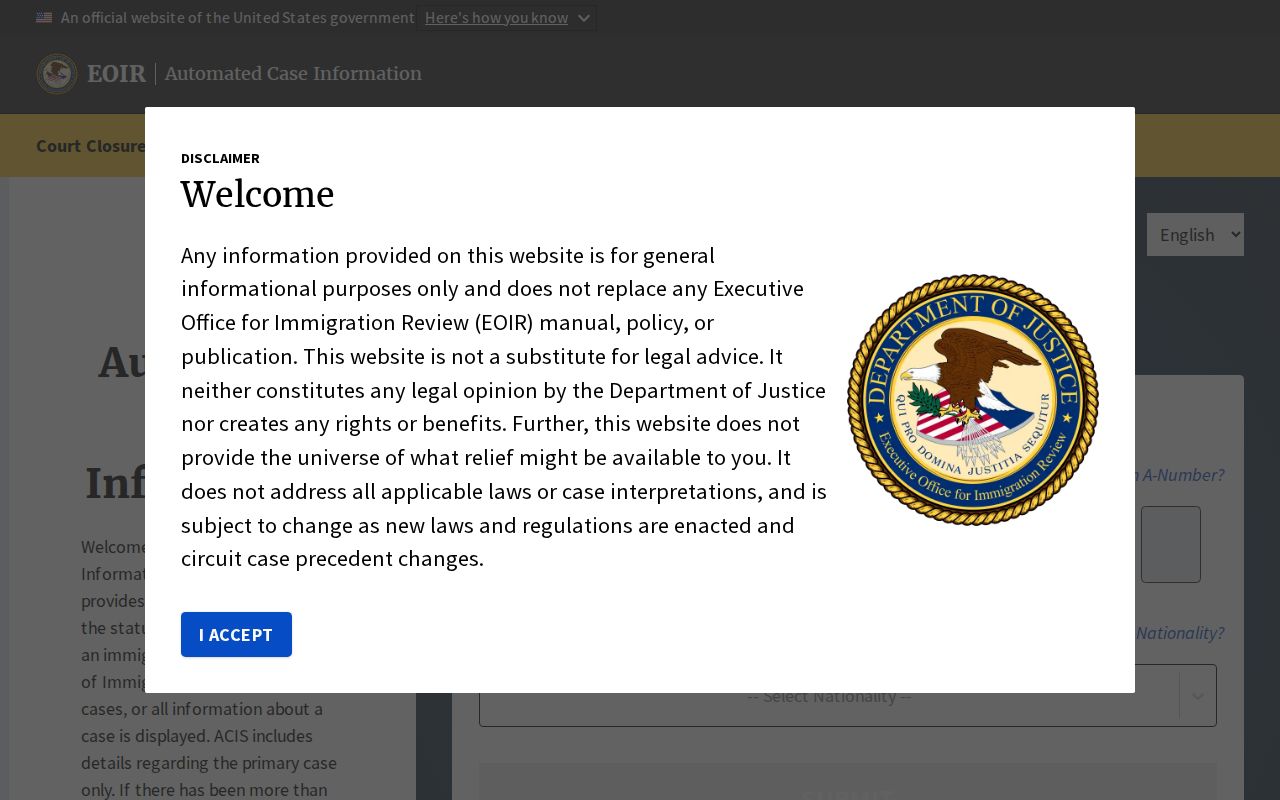
EOIR can add case context, but it does not establish detention or prove that a person left ICE custody. Use ODLS, ERO, and the county release record for custody status.
County Facility Tether Status
Chippewa County offers work-pass, electronic tether, and community-service programming. Tether and work release are changes in the mode of confinement, not automatic discharge from the case or from all controls. The Sheriff tether page describes court approval, screening, testing, a local place to stay, phone access, a required commissary balance, a schedule, and the absence of warrants among its operational requirements. The tether office can be reached at 906-635-6392.
Ask the jail to distinguish physical release from placement on tether or work release. A record may show that someone left the secure jail while still subject to county program rules. Court approval does not prove that enrollment was completed. Likewise, a program schedule does not show final discharge. The court file and Sheriff record together explain the legal authority, the actual start of the alternative placement, and any later end date.
- Tether
- Electronic monitoring that allows approved time outside the secure jail while controls continue.
- Work release
- A structured program allowing approved work activity without ending the underlying custody status.
- Detainer
- A request or legal basis for another authority to hold or receive a person.
County Release Court Trail
Chippewa County criminal cases can cross two local courts. The 91st District Court handles misdemeanors and the early stages of felony cases, including arraignment and preliminary proceedings. A felony that is bound over moves to the 50th Circuit Court for later felony proceedings. Searching only one court can leave a gap that looks like a missing disposition. Choose each court in MiCOURT and follow the case number, party name, and dates.
A register of actions can show bond decisions, hearings, a plea or trial result, sentence, and later orders. A signed bond or release order explains legal authority. It may not record the exact moment a booking officer checked every hold and processed the exit. For that fact, pair the court record with the Sheriff release sheet. If the felony resulted in a prison term, the county-jail departure may be an MDOC transfer, followed by an OTIS prison location rather than a community release.
Note: Search both Chippewa courts when a felony record stops after the District Court preliminary stage.
County Facility Records Contact
The correctional facility operates continuously, while the Sheriff business office publishes weekday business hours. Call the jail line for the custody event and the Sheriff business line for office routing. Staff may limit what can be given by phone, especially where protected facts are involved. A written FOIA request remains the better route for a record that must preserve the exact disposition and receiving custodian.
Chippewa County Correctional Facility
325 Court Street
Sault Ste. Marie, MI 49783
Jail: 906-635-7620
Sheriff: 906-635-6355
Fax: 906-635-6336
Business office: Monday-Friday, 8:30 a.m.-4:30 p.m.
When calling, ask a narrow question: did the person leave Chippewa County custody, on what date and time, under what disposition, and to the community or which receiving custodian? Record the office and date of the response. Do not ask for confidential supervision, medical, victim, or security details.
County Facility Transfer Signals
Chippewa County contains this county jail and two active MDOC prisons in Kincheloe. That mix makes building names a poor shortcut for custody status. MDOC unit announcements show that capacity changes can move prisoners between units or facilities. A new location at Chippewa Correctional Facility, Kinross Correctional Facility, or another MDOC institution is a transfer signal, not a county release.
The same rule applies in reverse. A person leaving the county facility for MDOC has ended the local jail stay but remains in prison custody. OTIS may then show the state prison and later change locations again. Only an OTIS parole status with a date paroled, an MDOC discharge status read in context, or an official MDOC record addresses the later state-prison release. Keep the county transfer date separate from any future parole or discharge date.
Regional planning also requires care. EUPTA operates scheduled Sault Ste. Marie to Kincheloe service, but neither the transit source nor the facility page promises a jail-provided ride or a jail-door pickup. Confirm routes and service directly at 906-632-2898 only after community release is verified.