
Understanding Chippewa County Releases
A release is the end of one agency's physical custody, but it does not always mean the person went home. The Chippewa County Sheriff records departures from the county correctional facility. The Michigan Department of Corrections, or MDOC, records prison parole, probation supervision, discharge, and transfers through OTIS. Federal Bureau of Prisons and Immigration and Customs Enforcement systems cover different federal populations. A useful Chippewa County release search begins by naming the last custodian and asking what happened next.
That distinction matters here. The county contains a local jail that also holds ICE detainees and two active MDOC prisons. A name that vanishes from one facility may reflect bond, time served, dismissal, parole, maximum discharge, transfer, removal, death, or a move to tether or work release. A live custody display usually stops showing someone after departure. The lasting proof is a release sheet, court order, OTIS status history, parole or discharge record, or a direct response from the agency that processed the event.
Chippewa County Release Paths
The release type tells a reader what a date proves and which record should follow. A bond date does not decide the criminal case. A transfer ends the stay at one building but continues custody elsewhere. Parole ends secure prison confinement while MDOC supervision continues. Even a time-served order may coexist with another warrant, detainer, or sentence. The jail's actual release disposition is the best source for the physical exit.
| Release path | Meaning | Next source |
|---|---|---|
| Bond or recognizance | Conditional release before the case ends | Jail release sheet and 91st District Court |
| Dismissal or acquittal | That charge ends, though another hold may remain | Court disposition and jail record |
| Time served or sentence completion | The county sentence is satisfied | Judgment, jail credit, and release sheet |
| Tether or work release | The person leaves secure housing under program control | Sheriff tether office and court terms |
| Parole | Prison ends but the sentence continues under supervision | OTIS status, date paroled, and supervising office |
| Transfer | Custody moves to MDOC, ICE, or another jail | Receiving custodian's locator or records office |
| Maximum discharge | MDOC jurisdiction ends for that sentence | OTIS profile or MDOC discharge record |
Inside a Chippewa Release Record
A focused request should identify the person and ask for the fields needed to answer who left, when county custody ended, why it ended, and who received the person. Chippewa County does not promise that every item below appears on one form. These are useful fields to request from the Sheriff, and the agency may withhold material under a valid exemption. Pair the response with a court record when the legal authority for release matters.
| Field | What it shows |
|---|---|
| Name, DOB, booking number | Connects the record to the correct booking |
| Booking and release date/time | Marks the start and processed end of the county stay |
| Charges, court, case number | Links the custody event to the legal case |
| Bond amount and type | Explains a pretrial release route |
| Release reason or disposition | Distinguishes bond, time served, completion, dismissal, and transfer |
| Hold or detainer | May explain why a court order did not produce community release |
| Receiving agency | Names the next custodian after a transfer |
| Booking photograph | Documents appearance at booking, subject to exemptions |
For a state prisoner, the equivalent proof may be an MDOC Basic Information Sheet, time computation, parole action, parole release information, or discharge certificate. OTIS is quicker, but it generally stops displaying a discharged record three years after supervision ends. That web-display rule is distinct from MDOC's other record-retention routes.
Request Chippewa County Release Records
The county provides a FOIA access page, a request form, and written procedures. Michigan law does not require a special form, so a clear email or letter can work. Address the request to the County Administrator/FOIA Coordinator at 319 Court Street, Sault Ste. Marie, Michigan. Ask for an electronic copy when practical and narrow the date range to reduce search work.
- Give the person's full name, date of birth, and booking number if known.
- State the arrest or booking date range and name the Chippewa County Correctional Facility.
- Request the booking/release sheet, processed release date and time, disposition, receiving custodian, and booking photo if needed.
- Ask for electronic delivery and a fee estimate before work above a chosen amount.
- Keep the response, cited exemptions, and appeal instructions with the record.
Under MCL 15.235, an agency generally must grant, deny, partially grant, or extend its response within five business days. One extension of up to ten business days is allowed. MCL 15.234 permits certain labor, copying, mailing, and media charges and provides a public-assistance discount when its conditions are met. A response deadline is not always the production date for a large request.
Michigan Law on Release Records
Michigan's Freedom of Information Act provides the framework for county and MDOC record requests. MCL 15.234 controls permissible fees, MCL 15.235 sets the response process, and MCL 15.243 lists exemptions. The Michigan Attorney General's FOIA Handbook explains that a sheriff booking photograph is a public record, subject to an exemption that actually applies. A label alone does not settle access.
A sealed, set-aside, expunged, juvenile, or otherwise nonpublic matter may change what an office can release or what a public portal displays.
OTIS generally displays a discharged MDOC record for three years after supervision discharge, including a discharge caused by death, unless removal occurs sooner through law. A set-aside can also alter public access. Neither an old cached page nor a third-party copy should be used to defeat a lawful restriction. For proof needed in a court or legal process, request the official record and preserve the custodian's response.
Bond Release in Chippewa County
The Chippewa County booking page directs bail and arraignment questions to the booking officer. It states that bonds are paid in cash or through a bail bondsman and that checks and foreign currency are not accepted. The 91st District Court explains that a judge or magistrate sets bond. Some minor offenses may have a standard bond that can be posted soon after booking, followed by a report date.
Posting bond authorizes pretrial release on that case. It does not dismiss the charge or prove that all holds cleared. Another warrant, probation hold, immigration detainer, or receiving-agency transfer can keep custody in place. When exact timing matters, compare the bond order and payment information with the Sheriff's processed release date and disposition.
Find a Released Chippewa Inmate
Start with the system tied to the last known custodian. Chippewa County has no verified official web roster or recent-release feed. The Sheriff mobile app supports offender searches, but its store listing does not promise a release window, photo, or retention period. A careful search then moves through event, court, records, and receiving-custodian sources.
- Check the official Sheriff app and record the exact agency, status, identifier, and date displayed.
- Search Michigan VINELink for the same person. Treat release and transfer as different events.
- Search MiCOURT in 91st District and, for a bound-over felony, 50th Circuit Court.
- Call the jail at 906-635-7620 and ask whether departure was to the community, tether, work release, or another custodian.
- Request the county release sheet for lasting proof.
- For prison history, search OTIS with All or Discharged status. For BOP or ICE custody, use the matching federal locator.
A person who drops off a live roster may have been released, transferred, removed, hospitalized, or moved under another hold; absence alone proves none of them.
OTIS Search for Chippewa Releases
The MDOC Offender Tracking Information System covers prisoners, parolees, many felony probationers, absconders, and recently discharged people. It does not cover a person held only in the county jail. Search by MDOC number when possible. Otherwise use exact name fields and enough identity facts to avoid a false match. Selecting All or Discharged matters because the default Active Offenders choice may hide the record sought.
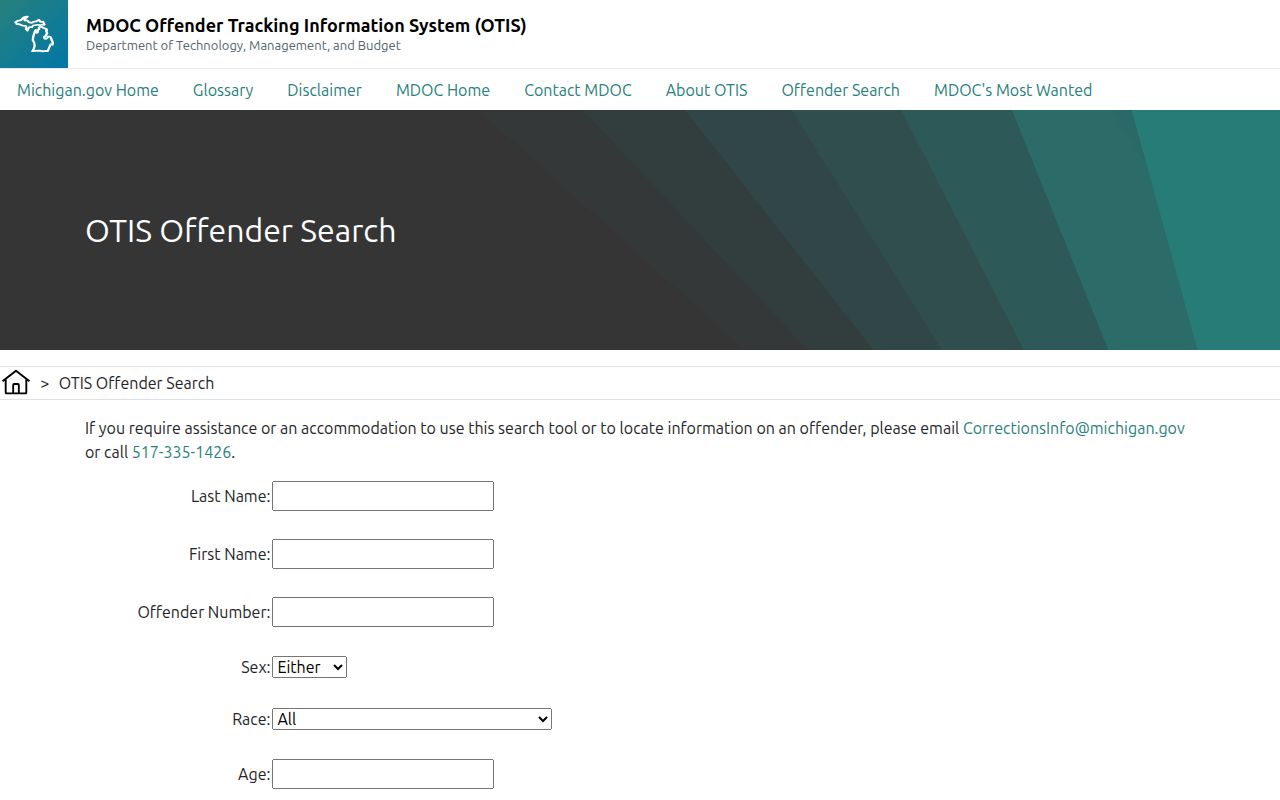
The form makes status a central search field, which is why a released-state-prison search should not remain on the active-only default.
| Search field | How it helps |
|---|---|
| Last and first name | Exact text search when the MDOC number is unknown |
| Offender number | Best way to isolate one MDOC record |
| Status | Includes All, Prisoners, Parolees, Probationers, Discharged, and absconders |
| Age, sex, race | Helps separate similar names |
| Marks, scars, tattoos | Provides another identity filter where appropriate |
On the profile, PAROLE means the person left prison but remains under MDOC jurisdiction. DATE PAROLED is the prison-exit date. DISCHRG means jurisdiction ended for that sentence, though the glossary includes more than one discharge route. Read location, sentence fields, and status together.
No Chippewa Recent-Release Feed
The official Sheriff and correctional-facility pages do not publish a verified 24-hour, 72-hour, or other recent-release list. They state no update pace, archive length, or online photo policy. Current bookings must not be relabeled as releases. The useful same-day path is the Sheriff app, the jail line, VINELink, MiCOURT, and a focused FOIA request.
Timing can differ across those channels. A court may enter an order before jail staff finish hold checks and processing. A VINE event may arrive after the source system changes. The mobile app may show only its current feed. When a precise release time or destination matters, the Sheriff's responsive record is the durable source.
Chippewa Supervision After Release
MDOC Field Operations Administration supervises parolees and many felony probationers. Parole follows prison and continues the sentence in the community. Probation comes from the sentencing court and may occur without a prison term. OTIS status and location show the public supervision category; the Chippewa County Parole/Probation office can address an unclear state record.
The office is at 325 Court Street, Suite 102, in Sault Ste. Marie and can be reached at 906-635-6345. Chippewa's 91st District Court probation operation is separate. Match the office to the court or agency that imposed supervision. An absconder status is not discharge, and private supervision details should not be sought or republished when public status is enough.
Chippewa Release Alerts and Locators
MI-VINE can report county release, transfer, and escape events and can provide a general release notice for MDOC prisoners. It is a notification service, not a permanent archive. Search a specific person, compare the identifier and agency, then preserve the exact event language. A transfer notice means custody continued. Phone registration uses a four-digit PIN; unacknowledged calls may repeat for up to 72 hours.
The BOP Inmate Locator covers federal prisoners and may show a release date or a noncustody status. It does not rule out later state, county, or immigration custody. People in U.S. Marshals pretrial custody may instead require the federal court docket. ICE's locator is mainly a current-location tool. A no-match can reflect transfer, removal, release, lag, or a protected record, so it is not a release certificate.
Where Chippewa Release Status Appears
Each source records a different slice of the custody path. Compare scope before deciding that two systems conflict. A court entry can authorize release while the jail still processes it. OTIS can show a prison transfer that has no bearing on the county's live offender display. The agency that owns the disputed fact should resolve it.
| Source | Still in custody | After departure |
|---|---|---|
| Sheriff app or jail | Current local custody may appear | Release sheet confirms time, reason, and destination |
| MiCOURT | Orders and case events may explain detention | Disposition and sentence show legal context, not always exit time |
| OTIS | Prison location and status | PAROLE, DATE PAROLED, DISCHRG, or supervision location |
| VINELink | Contributor custody status | Release or transfer event, not a permanent archive |
| BOP | Federal prison location | Federal release date or noncustody status |
| ICE ODLS | Current immigration location where published | No result is inconclusive |
Chippewa Release Records Cross Courts
Local felony cases can cross a court boundary. The 91st District Court handles arraignment and preliminary stages. When a felony is bound over, the 50th Circuit Court handles the later felony case, sentence, and orders. Searching only one court can leave an apparent gap where jurisdiction changed.
The MiCOURT Case Search lets a reader select the court and search by party or case number. A district-court bond order may explain why jail release became possible, while the circuit record supplies the lasting disposition. Neither replaces the Sheriff's actual exit time. For a filed order or judgment, use the Chippewa County clerk's document-request process.
ICE Transfers from Chippewa County
Chippewa County Correctional Facility is also an ICE intergovernmental-service-agreement site for detention beyond 72 hours. This makes the word “released” especially risky without a destination. A local booking may end with transfer to ICE, and an immigration detainee may leave the building through transfer or removal rather than community release.
Use the county release sheet to learn whether local custody ended “to ICE.” Then search ICE ODLS by A-number and country of birth or by biographical details. An immigration-court case in EOIR can add procedural context, but it does not show detention. If the locator returns no match, contact the responsible ICE office instead of treating silence as proof of freedom.
Travel After a Chippewa Release
The Eastern Upper Peninsula Transportation Authority runs scheduled service between Sault Ste. Marie and Kincheloe, the community where both state prisons are located. Neither EUPTA nor the facilities promise a jail-provided ride or a stop at a secure entrance. A released person or family should confirm the route, pickup point, accessibility needs, and holiday schedule directly with EUPTA at 906-632-2898.
Transportation planning should begin only after the release location and time are confirmed. A person transferred between Chippewa Correctional Facility, Kinross Correctional Facility, or another MDOC location has not entered the community and will not use a public pickup plan. Likewise, ICE transfer needs a federal custody follow-up, not a bus itinerary.
Chippewa Prison Moves Aren't Releases
MDOC housing operations in Chippewa County have changed over time. State announcements report that a Level II unit at Chippewa Correctional Facility reopened in 2024, while a 2026 initiative temporarily closed a Level II unit and moved residents to other units or facilities. Those local changes show why a new prison location must be read as a transfer signal.
In OTIS, look for PAROLE or DISCHRG rather than relying on LOCATION alone. A shift from Chippewa to Kinross, or to another prison, means secure custody continues. VINELink may also issue a transfer notice. When the reason for a move is not public, avoid guessing; the release question is answered by status, date-paroled information, and MDOC records.
Chippewa County Release Facilities
Three facilities require distinct follow-up paths. Chippewa County Correctional Facility is the Sheriff-run jail and an ICE contract site; its county release sheet, court record, VINE event, and ICE check distinguish community release from transfer. Chippewa Correctional Facility is an MDOC men's prison with Levels I, II, and IV, while Kinross Correctional Facility is an MDOC men's prison with Levels I and II. OTIS and MDOC records control prison parole, discharge, and transfer questions.
- Chippewa County Correctional Facility: county jail release, tether, transfer, or ICE path.
- Chippewa Correctional Facility: OTIS parole, discharge, or intra-MDOC transfer.
- Kinross Correctional Facility: the same MDOC route, with location history checked carefully.
Identity matching is essential in every system. Use an agency identifier, booking or MDOC number, case number, and lawfully displayed date of birth before attributing a Chippewa County release record to one person.